








The Silhouette of a Decade
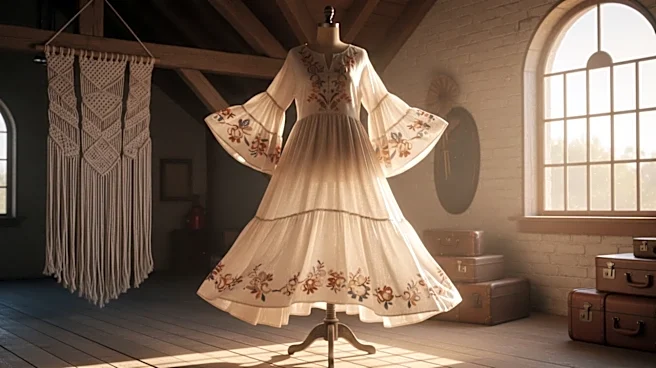
The defining look of 1970s bohemianism was the long, flowing dress. Often called a "granny dress" or, more famously, a "prairie dress," this silhouette rejected the space-age mini-skirts and sharp A-lines of the 1960s. Instead, it embraced modesty and romance
with high necklines, long sleeves (often puffed or belled), and midi- or maxi-length skirts, frequently adorned with ruffles, lace trim, and small-scale floral prints. This wasn't the wardrobe for a sterile, futuristic world; it was clothing for an escape into nature, art, and a softer, more introspective way of life. Brands like Gunne Sax, founded in San Francisco, became legendary for perfecting this aesthetic, blending fabrics like calico and muslin with corset-style bodices and intricate lace details.
A Nostalgic Look Backward
This romantic silhouette wasn't a new invention. It was a direct and conscious borrowing from earlier historical periods, primarily the late Victorian and Edwardian eras (roughly the 1890s to 1914). The high collars, lace inserts, and long, graceful lines were lifted from an idealized vision of turn-of-the-century femininity. This was combined with a romanticized take on 19th-century American pioneer life, giving rise to the "prairie" look championed by designers like Ralph Lauren. The style was a pastiche, a dream of a past that felt simpler and more authentic. Designers like Jessica McClintock for Gunne Sax and Britain's Laura Ashley built empires on this nostalgia, reimagining historical silhouettes for a new generation.
Why Look Back? A Cultural Escape
The turn to historical fashion wasn't just an aesthetic choice; it was a cultural reaction. The 1970s were a period of social upheaval. Coming out of the turbulent 1960s, with the ongoing Vietnam War and a growing disillusionment with modern society, many young people sought an escape. The back-to-the-land movement gained traction, and with it came a desire for clothing that felt handmade, natural, and disconnected from the mainstream establishment. The prairie dress was the uniform for this romantic escapism. It was anti-fashion, a rejection of the slick, synthetic consumerism that defined much of postwar culture. In the words of designer Laura Ashley, these clothes provided "the security of nostalgia" for people who wanted to feel grounded in a chaotic world.
The London Scene: Biba and 1930s Glamour
While the prairie look defined one side of the '70s, another historical revival was happening simultaneously, particularly in London. The legendary boutique Biba, run by Barbara Hulanicki, looked to the slinky, elegant glamour of the 1930s and Art Deco period. This different flavor of bohemianism swapped rustic florals for dark, decadent velvets, satins, and crepes. The silhouettes were long and fluid, inspired by the bias-cut gowns of Old Hollywood, but rendered in moody, dusty colors like plum, rust, and mulberry. Like the prairie dress, the Biba look was a form of escapism, but instead of a countryside idyll, it conjured a world of smoky nightclubs and bygone silver-screen elegance. It proves that the '70s impulse to borrow from the past was not monolithic, but a widespread yearning for romance in many forms.