
First, Forget Everything About a Buzzer
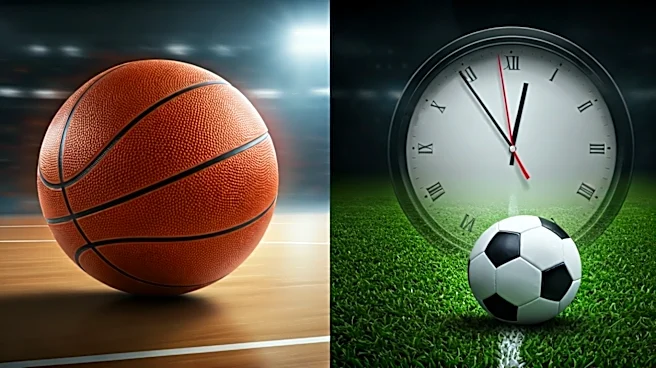
The biggest mental hurdle for a basketball fan watching soccer is the clock. In basketball, the game is a slave to the clock. It’s a precise, 48-minute countdown (or 40 in college) where every tenth of
a second is accounted for. The clock stops for dead balls, timeouts, fouls, and video reviews. Soccer throws that entire concept out the window. A professional soccer match has two 45-minute halves. The clock starts at 0:00 and counts *up* to 45:00. Crucially, it almost never stops. A player gets injured? The clock runs. A substitution happens? The clock runs. The ball goes out of bounds? The clock runs. This continuous flow is fundamental to the sport. Instead of stopping the clock, the referee keeps a mental (and literal) tally of time lost during these interruptions.
Meet 'Stoppage Time'
So what happens to all that lost time? It gets paid back at the end of the half. This is “stoppage time,” also known as “added time” or “injury time.” Think of it like this: Imagine if, in the final two minutes of a Lakers-Celtics game, the official game clock kept running during free throws and timeouts. Then, once the clock hit 0:00, a referee announced, “Okay, based on all those delays, we’re going to play another 1 minute and 45 seconds.” That’s essentially stoppage time. The center referee is the sole keeper of this time. At the end of each half, the fourth official holds up an electronic board showing the *minimum* number of extra minutes that will be played. It can, and often does, go longer if there are more delays within stoppage time itself.
What Buys You More Time?
The referee is tracking several key events to determine the amount of stoppage time. According to the official Laws of the Game, time is added for: * **Substitutions:** Each team typically gets five subs, and each one eats up 20-30 seconds. * **Injuries:** Assessing and treating an injured player can add minutes. * **Time-wasting:** This is the soccer equivalent of a team without fouls to give, just trying to bleed the clock. Players might take forever on a throw-in or feign injury. The ref sees this and adds it to the bill. * **VAR (Video Assistant Referee) checks:** Just like an NBA official review, these can cause significant delays. * **Goal celebrations:** The pure joy of scoring comes at a cost—usually a minute added on. * **Disciplinary actions:** Issuing yellow or red cards also stops the active run of play.
The Strategic Difference: Certainty vs. Chaos
This is where the strategy diverges completely from basketball. In the NBA, a coach with timeouts and a foul to give has a high degree of control over the final minute. They can stop the clock to set up a play or extend the game by fouling. Certainty is the name of the game. In soccer, there is no such certainty. A team that is winning wants the half to end as quickly as possible. A team that is losing is desperate for more time. But since no one knows the *exact* second the game will end, it creates a unique kind of frantic, desperate energy. You can’t “ice” the game with a timeout. You can’t strategically foul to stop play. You just have to keep defending (or attacking) until you hear the final whistle. This uncertainty is why so many dramatic, late goals happen in stoppage time, a phenomenon famously dubbed “Fergie Time” after the many late winners scored by Sir Alex Ferguson’s Manchester United teams.
A Quick Note on 'Extra Time'
Don't confuse stoppage time with “extra time.” They are two different things. Stoppage time happens at the end of every half. Extra time, however, is soccer's version of overtime. If a knockout match (like in the World Cup or a cup final) is tied after the full 90 minutes plus stoppage time, the game goes to extra time. This is a distinct period of play, usually two 15-minute halves. It’s not just a few added minutes; it's a whole new mini-game to decide a winner. And yes, each of those 15-minute extra time halves will have its own stoppage time added at the end. If it's *still* tied after all that? It’s on to the gut-wrenching drama of a penalty shootout.