


A Bold Old-School Gamble
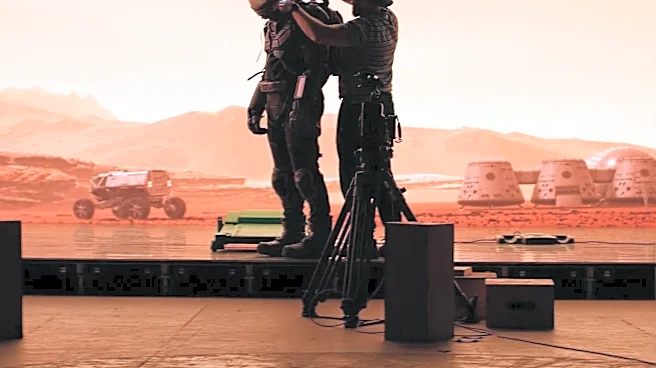
In an era dominated by digital worlds, directors Phil Lord and Chris Miller made a stunningly old-school decision for their sci-fi epic: they built the spaceship for real. For the scenes inside the titular Hail Mary, the production team constructed elaborate,
fully functional sets, almost entirely avoiding the use of green or blue screens. Co-director Chris Miller confirmed that not a single green screen was used for the ship's interiors, a move designed to ground the story in a tangible reality. This wasn't about completely abandoning modern technology—sweeping exterior shots of the ship in space were handled with digital effects—but about the environment the actors inhabited. The choice was to create a physical playground for star Ryan Gosling, letting the camera and the actor discover the world together, rather than building it later in post-production.
Grounding a Performance in Zero-G
The most powerful argument for practical sets isn't technical; it's human. Project Hail Mary is a story of profound isolation, and Gosling’s performance as the amnesiac astronaut Ryland Grace is central to its success. By giving him a real, physical environment to interact with, the filmmakers gave him something to push off of, both literally and figuratively. He could touch the walls, press actual buttons, and react to the ship around him in real time. This extends to his alien companion, Rocky, who was brought to life on set through sophisticated puppetry before being enhanced with animation. An actor reacting to a physical puppet operated by a performer is always going to feel more authentic than one staring at a tennis ball on a stick. This commitment to physical reality helps translate the character’s disorientation and eventual mastery of his environment directly to the audience.
Lessons from the Sci-Fi Masters
Lord and Miller are walking a path paved by giants of the genre. Stanley Kubrick’s 2001: A Space Odyssey created its iconic weightless scenes decades before modern CGI, using enormous, rotating centrifuge sets that simulated gravity. To make a pen float, the effects team attached it to a simple sheet of glass and rotated it. Likewise, for Apollo 13, director Ron Howard shot scenes in genuine weightlessness by filming inside a KC-135 aircraft—nicknamed the “Vomit Comet”—as it performed parabolic arcs, giving the actors about 25 seconds of real zero-G at a time. The visceral realism in those films is undeniable, and it stems from solving a physical problem with physical ingenuity. The Hail Mary team is tapping into that same tradition, betting that a tactile world creates a more immersive experience.
It's About Smarter Spending, Not Just Less
While building massive sets sounds expensive—and it is—the financial logic is more nuanced than simply “practical is cheaper.” The cost of high-end, photorealistic CGI can be astronomical, especially when it involves complex interactions with actors over long stretches of a film. It also opens the door to endless, costly tweaks in post-production. By investing heavily in the practical sets upfront, the production locks in a high-quality, believable environment. This approach avoids the dreaded “plastic” look that often plagues films with rushed or overworked visual effects, a common complaint even for big-budget blockbusters. It's a strategic investment in authenticity, ensuring the film's core environments have a weight and texture that digital creations often struggle to replicate. The money is spent on what’s right in front of the camera, not on fixing it later.