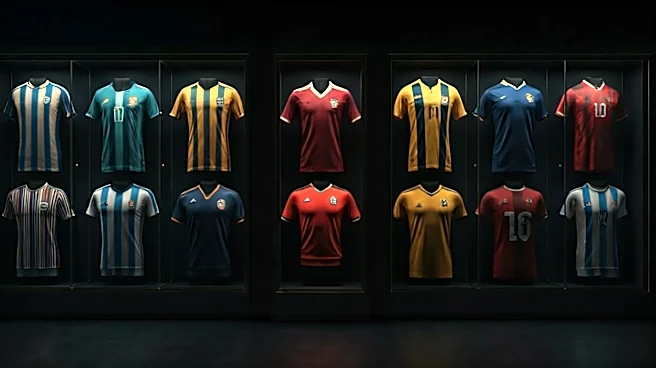








USA, 1994: The Infamous “Denim Stars”
When the U.S. hosted the World Cup in 1994, the sport was still a niche curiosity for most Americans. So, what did they wear? A jersey that looked like it was made of stone-washed denim and splattered with giant, abstract stars. It was loud, a little
goofy, and unapologetically American. At the time, global purists scoffed. But history has been kind. The '94 kit has become a beloved cult classic, a symbol of a moment when American soccer stepped onto the world stage with awkward but endearing confidence. It represents the start of the modern soccer era in the States, worn by players like Alexi Lalas and Cobi Jones who became household names. It’s the ultimate thrift-store find and a perfect symbol of 90s swagger.
Argentina, 1986: The Canvas for a God
The simple, sky-blue and white vertical stripes of the *Albiceleste* are always classic. But the 1986 version is sacred. This is the uniform Diego Maradona wore when he single-handedly dragged Argentina to World Cup glory. In a single quarter-final match against England, this jersey witnessed both the infamous “Hand of God” goal and the “Goal of the Century,” a mazy, miraculous dribble that is still considered the greatest ever scored. The shirt itself isn't flashy. Its power comes entirely from its association with Maradona at the absolute peak of his powers. It’s a holy relic, a symbol of flawed genius and the belief that one player can bend a tournament to his will.
Netherlands, 1988: The Geometric Masterpiece
Often cited as the best-looking soccer jersey of all time, the Netherlands’ 1988 kit is a work of abstract art. The vibrant orange is broken up by a sublimated geometric pattern that was revolutionary for its time. But it’s not just about looks. The Dutch team, featuring legends like Marco van Basten, Ruud Gullit, and Frank Rijkaard, played a fluid, dominant style of soccer that won them the European Championship that year. Van Basten’s impossible volley in the final is one of the sport’s most replayed moments, and he scored it wearing this jersey. The kit has become shorthand for a generation of Dutch cool and a style of play that was as beautiful as the shirts they wore.
West Germany, 1990: The Dawn of 90s Cool
Before Germany was reunified, West Germany won its third World Cup in this stunner. The design, featuring a jagged, geometric band in the colors of the German flag across a clean white base, was unlike anything seen before. It was modern, aggressive, and perfectly captured the aesthetic of the dawning decade. Worn by stoic captain Lothar Matthäus as he lifted the trophy, the jersey became an instant design icon. Its influence was so immense that its pattern was copied and riffed on by clubs and countries for years. It represents the last triumph of West Germany and the beginning of a new era in soccer kit design.
Nigeria, 2018: The Modern Hypebeast
Fast forward to the modern era. For the 2018 World Cup, Nike designed a kit for Nigeria's “Super Eagles” that paid homage to their iconic 1994 shirt. The result was a cultural phenomenon. The zig-zagging green, white, and black pattern was an instant hit, blending retro cool with modern energy. It sold out globally within minutes, creating queues outside stores and fetching huge sums on resale markets. The jersey proved that a kit could transcend the pitch and become a genuine fashion item. It showed the power of national identity and smart design in the social media age, becoming the most talked-about piece of apparel of the entire tournament before a ball was even kicked.
Brazil, 1970: Simple, Joyful Perfection
Sometimes, the most iconic look is the simplest. The bright canary yellow shirt, paired with blue shorts and white socks, is synonymous with Brazil and a joyful, attacking style of soccer known as *joga bonito* (the beautiful game). The 1970 World Cup team, led by the legendary Pelé in his final tournament, is arguably the greatest national team ever assembled. This was also the first World Cup broadcast in color, and Brazil’s vibrant kit popped off the screen. The jersey isn't iconic because of a fancy pattern; it's iconic because it represents soccer at its purest and most dominant—a symbol of Pelé, a third star on the crest, and a nation that plays with unmatched flair.