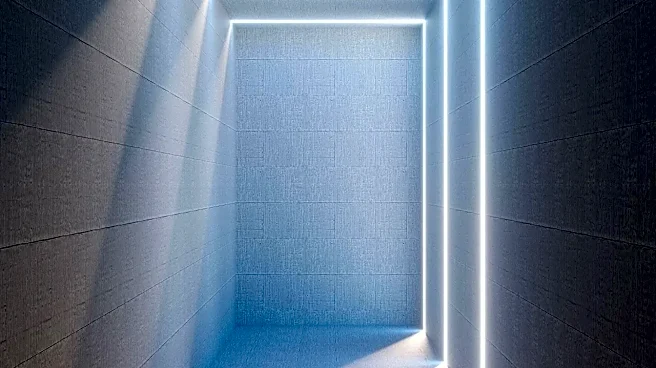

The Hollywood Hallway Illusion
In the world of production design, efficiency is an art form. The idea that a single reusable corridor could support a huge chunk of a film isn't just hyperbole; it’s a strategy built around modular sets.
These aren't just one fixed hallway that gets a new coat of paint. Instead, think of them as a sophisticated set of building blocks. Production designers create a series of walls, corners, and doorways that can be quickly reconfigured. These elements are often called "wild walls"—stretches of a set that can be removed to allow cameras and crew to get a shot from outside the room. This modularity is the key. By swapping out panels, adding new doorways, or changing the configuration, a 40-foot stretch of corridor can be transformed into a dozen different locations within the film's universe.
Designing for Deception
The magic is in the details. A production team can make one corridor feel entirely new through a combination of four key elements: set dressing, lighting, paint, and camera angles. A futuristic sci-fi passage becomes a grimy industrial tunnel by adding exposed pipes, steam effects, and flickering, cool-toned lighting. The same core structure can be repainted and dressed with ornate wallpaper, sconces, and wooden doors to become a Victorian mansion's hallway. Cinematographers contribute by using different lenses and camera movements; a wide-angle lens can make a short corridor seem vast, while tight, handheld shots create a sense of claustrophobia. By focusing on what the camera sees—and, more importantly, what it doesn't see—filmmakers can build a world that feels expansive on a budget that is anything but.
You've Seen It a Thousand Times
This technique is a cornerstone of genre filmmaking, where budgets are often tight and worlds need to feel immense. The original "Star Trek" series was famous for its endlessly reconfigurable corridors and rooms aboard the USS Enterprise. James Cameron’s sci-fi horror classic "Aliens" masterfully reused sets to create the labyrinthine Hadley's Hope colony; some of those same sets, still standing in a disused power station, were later redressed by Tim Burton for scenes in his 1989 "Batman". Even Christopher Nolan’s mind-bending thriller "Inception" relied on this principle. The famous rotating hallway scene was a masterpiece of engineering, but other corridors in the film were modular designs, allowing the crew to create different hotel floors and dreamscapes from the same basic components.
The Genius and the Gamble
The primary benefit of a reusable set is, of course, financial. Building fewer sets saves enormous amounts of money on materials and labor, freeing up the budget for other crucial departments like visual effects, costumes, or securing on-screen talent. It also saves precious time on a shooting schedule, as the crew can quickly reconfigure a set overnight rather than moving to an entirely new location. But there's a risk involved. If not executed with skill and careful planning, audiences might spot the repetition. A discerning viewer might notice the same distinctive doorway or ceiling pattern appearing in what are supposed to be different parts of the world. This can shatter the suspension of disbelief, pulling the audience out of the story. The goal is for the production design to be so effective that its tricks go completely unnoticed.