





Harrison Ford: The Weary Action Hero
The line from Humphrey Bogart to Harrison Ford is practically a straight one. Think of Bogart's Rick Blaine in Casablanca: a cynical, world-weary man who wants nothing to do with the larger fight but gets pulled in by his own buried conscience. Now think
of Han Solo. Ford perfected the archetype of the reluctant hero who projects a gruff, self-interested exterior to protect a core of decency. His performances in Star Wars and as Indiana Jones are defined by a Bogart-like sense of exasperation. He’s not a superhero; he’s a capable guy who is constantly in over his head and annoyed by it. Like Bogart, Ford's charm isn’t in being smooth, but in being believably flawed and ultimately dependable when it counts. His portrayal of Rick Deckard in Blade Runner is perhaps the most direct echo, a classic film noir detective grappling with a morally ambiguous world, a role Bogart would have understood completely.
Denzel Washington: The Man with a Moral Code
Humphrey Bogart’s characters were often guided by a personal, unspoken code of ethics. They might operate in the criminal underworld or on the fringes of society, but their actions were dictated by an internal sense of justice. Denzel Washington has built a career playing men of immense moral gravity. Whether it's a vigilante with a past like Robert McCall in The Equalizer or a man pushed to the edge by a broken system in John Q, Washington’s characters wrestle with what is right in a world of wrong. Like Bogart, he commands the screen with a quiet intensity, conveying complex thoughts and deep-seated convictions with a single look. He can play villains like the corrupt detective Alonzo Harris in Training Day, but even then, the character operates on a twisted version of his own code, a dark reflection of the Bogart anti-hero. Washington embodies the weight of a man's decisions, a hallmark of Bogart's most compelling roles.
Daniel Craig: The Bruised, Vulnerable Brawler
When Daniel Craig rebooted James Bond in Casino Royale, he stripped away the suave invincibility and replaced it with something far more interesting: a blunt, brutal instrument who was visibly wounded by his work. This Bond was tough and capable, but also emotionally scarred and prone to making mistakes. It was a portrayal deeply indebted to the Bogart model of masculinity—strong, yes, but also breakable. Bogart’s heroes often had a dark, vulnerable side, and his tough exteriors were a form of armor. Craig’s Bond is the epitome of this, a man whose physical toughness is a direct response to his emotional vulnerability. He’s a brawler, not a fencer, and his weariness feels earned. The cynical shell, the distrust of authority, and the flicker of a bruised heart beneath the violence are all traits that link Craig’s 007 directly to Bogart’s hard-boiled detectives.
Oscar Isaac: The Chameleon with a Weary Soul
Part of Bogart's genius was his ability to make cynicism endearing. He played men who were morally ambiguous, caught between their better angels and their worst impulses. Oscar Isaac possesses a similar chameleonic ability, specializing in characters who live in the gray. In A Most Violent Year, he plays a man trying desperately to remain honorable in a corrupt world. In Inside Llewyn Davis, he’s a deeply talented but self-destructive artist. In Moon Knight, he plays a mercenary with a fractured moral compass. Isaac excels at portraying an internal struggle, a soulfulness that often seems at odds with his characters' circumstances. Like Bogart, his charisma is complex; it’s not just charm, but a magnetic weariness that suggests a long, difficult history. He can be a hero, a villain, or something in between, but he always brings a depth and intelligence that makes his characters feel profoundly human and conflicted.
Josh Brolin: The Gruff, Hardened Realist
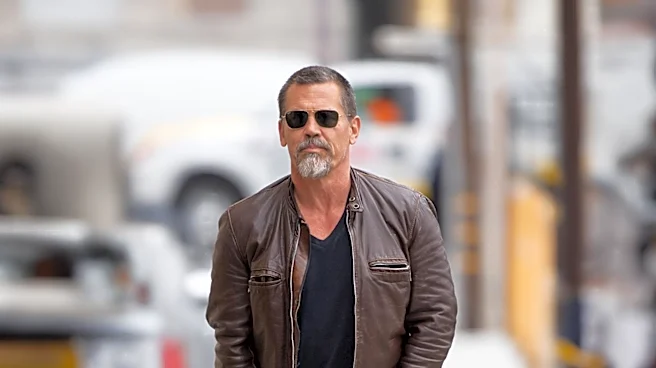
If Bogart mastered the art of playing men hardened by life, Josh Brolin is his modern heir. Often typecast as gruff, tough-guy characters, Brolin brings a surprising nuance to these roles. His performance as Llewelyn Moss in No Country for Old Men is a masterclass in quiet desperation, a man whose pragmatism is tested by extraordinary circumstances. It echoes Bogart's turn as the paranoid Fred C. Dobbs in The Treasure of the Sierra Madre, where greed slowly eats away at a man's soul. Brolin’s characters, from the stoic Gurney Halleck in Dune to the cosmic tyrant Thanos in the Marvel Cinematic Universe, often carry a heavy, world-weary authority. He excels at playing men who have seen too much and speak with the gravelly voice of experience, a quality that defined Bogart's persona as the ultimate cinematic realist.
Idris Elba: The Commanding, Charismatic Presence
Humphrey Bogart had an undeniable screen presence; you couldn't take your eyes off him. He could dominate a scene with minimal effort, conveying authority and intelligence through sheer force of personality. Idris Elba shares this rare quality of commanding presence. Whether he's playing a maverick detective in Luther or the terrifying Commandant in Beasts of No Nation, Elba has a gravitas that is immediately captivating. Like Bogart, his characters often project an effortless coolness and control, even when they are in immense turmoil. This authority allows him to play both heroes and villains with equal conviction. His Stringer Bell in The Wire is a brilliant example—a charismatic, intelligent criminal who operates with a chilling logic, a complex figure Bogart would have excelled at playing. Elba’s ability to be both magnetic and menacing, often at the same time, is a direct link to Bogart's enduring power.