


The Race That Sound Always Loses
The core of the problem is a simple race between light and sound, and sound is hopelessly outmatched. Light travels at an astonishing 186,000 miles per second, meaning the visuals from the stage and video screens reach your eyes virtually instantly. Sound,
however, is a slowpoke. It moves through air at roughly 1,125 feet per second, or about 767 miles per hour. At a large festival where you might be 500 or 1,000 feet from the stage, that creates a noticeable, disorienting lag between what you see and what you hear. Your brain registers this mismatch as an annoying echo or a muddy, unintelligible smear of music. Simply blasting the main speakers louder won't solve this; it just makes the problem louder.
Why More Speakers Aren't Enough
So, why not just place more speakers throughout the crowd? It seems like an obvious fix, but if all those speakers fire at the same time, they create an even bigger sonic disaster. A person standing near a speaker halfway back would hear its sound first, then, a fraction of a second later, the sound from the main stage would arrive, creating a powerful and distracting echo. The sound from other speakers would arrive at slightly different times, creating a chaotic wash of noise. To make a massive field feel like an intimate venue, engineers need to do more than just make the music louder; they have to make it arrive everywhere at the same time.
Enter the Unsung Heroes: Delay Towers
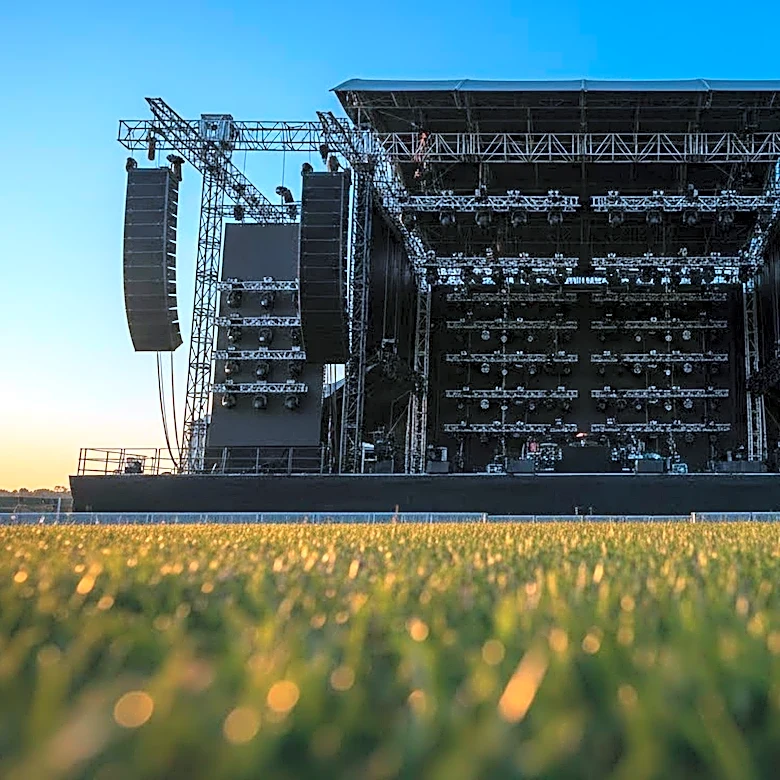
Those tall, lonely towers of speakers you see dotted throughout the festival grounds are the solution. They are called delay towers, and their job is not just to reinforce the sound, but to correct its timing. By placing these speaker systems at strategic distances from the main stage, audio engineers can create a seamless field of sound. The key isn't just the speakers themselves, but the sophisticated digital processing that controls them. Each tower receives the audio signal and holds onto it for a precise number of milliseconds before playing it.
The Simple Math of Perfect Sound
This is where the "hidden math" comes in, and it's surprisingly straightforward. The formula is Time = Distance / Speed. An audio engineer measures the distance from the main stage speakers to a delay tower. Let's say a tower is 450 feet away. Knowing that sound travels at about 1,125 feet per second, the engineer can calculate how long it takes for the sound to travel that distance: 450 ft / 1,125 ft/s = 0.4 seconds, or 400 milliseconds. The audio signal sent to that tower is then digitally delayed by exactly 400 milliseconds. The result? The sound wave from the main stage and the sound wave from the delay tower arrive at a listener standing near the tower at the exact same moment. The echo is gone, replaced by clear, powerful, and seemingly immediate sound. At major Grant Park events like Lollapalooza, engineers set up multiple rings of these towers to ensure this sonic magic covers the entire park.
Fine-Tuning Against the Elements
It doesn't stop with a simple calculation. Professional audio engineers are constantly fine-tuning these delays. The speed of sound isn't constant; it changes with air temperature and humidity. Sound travels faster in warmer, more humid air. These subtle shifts, along with wind, can bend sound waves and alter the timing. During a long festival day, as the sun sets and the air cools, an engineer might make micro-adjustments to the delay times to keep the system perfectly aligned. They use specialized software to model the space beforehand, but the final tweaks are often done by ear, walking the field to ensure the experience is seamless from front to back.