

From Gibson Girls to Chanel
The story of the bow blouse begins long before it became a workplace staple. Its ancestor is the lavallière, a floppy cravat popular with both men and women in 18th-century France. By the late 19th and early 20th centuries, it was adopted by the “Gibson
Girl,” the new ideal of American womanhood who was independent and active. This early version was a feminine answer to the male necktie, a way to look polished and forward-thinking. Fashion titans like Coco Chanel and Yves Saint Laurent later cemented its status. Chanel incorporated it into her modern, functional designs in the 1950s, while Saint Laurent made it a centerpiece of his revolutionary 1966 “Le Smoking” suit, a tuxedo for women that was a radical statement on gender and style.
The Politics of the Power Blouse
The blouse's most potent chapter came during the 1970s and '80s, when women entered corporate America in unprecedented numbers. Faced with navigating male-dominated offices, women adopted a version of the male uniform: the power suit. The bow blouse—often called a "pussy-bow blouse" after a 1934 pattern description—became the perfect feminine counterpart to the man's tie. It softened the sharp shoulder pads of power suits while signaling authority. British Prime Minister Margaret Thatcher famously made it her signature, believing the bow was "rather softening" to her "Iron Lady" image, a strategic choice for a woman leading in a man's world. The blouse became a uniform for shattering the glass ceiling, a symbol of feminine power that was both seen and heard.
A Canvas for Every Body and Style
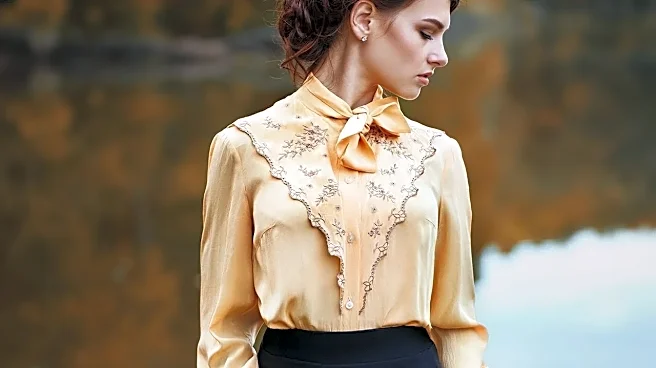
Beyond its political weight, the bow blouse survives because of its incredible versatility. The headline promise of working for “every body type” isn’t an exaggeration. The bow itself acts as a focal point, drawing the eye upward and elegantly framing the face. The ties can be adjusted for any occasion or figure: tied in a tight, neat bow for a preppy, professional look; left loose and drapey for a more romantic or relaxed vibe; or even knotted asymmetrically for an edgier feel. This adaptability makes it a true wardrobe chameleon. For those with a larger bust, a loosely tied bow in a soft fabric can drape beautifully without adding bulk. For narrower shoulders, a more voluminous bow can add balance and visual interest. It can be tucked into high-waisted trousers for a polished look, worn with jeans for casual chic, or layered under a sweater with just the bow peeking out.
The Modern Revival
Today, the bow blouse is free from the strict codes of 1980s power dressing. It appears on runways every season, reinterpreted by designers from Gucci to Saint Laurent. Its presence in the wardrobes of modern figures, from royals like Kate Middleton to political leaders like Kamala Harris, shows its enduring symbolism. The blouse even courted controversy when Melania Trump wore a Gucci pussy-bow blouse to a presidential debate in 2016, sparking a media frenzy about its potential meaning and proving the garment still carries immense symbolic weight. But for most women today, wearing a bow blouse is a conscious style choice rather than a workplace requirement. It’s a nod to history, a display of personal style, and a testament to a garment that has always balanced femininity with fortitude.