

An Impromptu Bonfire on the Beach
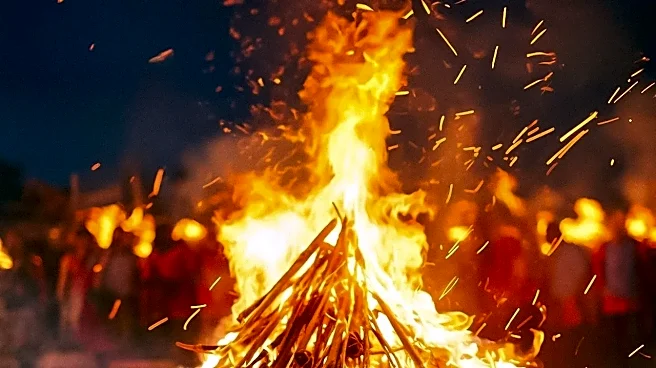
The story begins on San Francisco's Baker Beach. On the summer solstice of 1986, Larry Harvey and Jerry James built an eight-foot wooden effigy from scrap lumber, hauled it to the shore with about a dozen friends, and set it on fire. It was a spontaneous
act of what Harvey later called "radical self-expression." As the figure burned, a small crowd of beachgoers was drawn to the flames. A stranger impulsively held the burning figure’s hand, while another began singing a song about fire. In that moment, something more than wood was kindled: a community formed around a shared, unscripted experience. For the next few years, the ritual was repeated, with the man growing taller and the crowds getting bigger each time.
From the Beach to the Desert
By 1990, the gathering had become too large and fiery for a public beach. After police prohibited the burn that year, the event needed a new home. Organizers, now connected with the San Francisco Cacophony Society, a group known for staging bizarre and unpredictable public events, were invited on a trip to the Black Rock Desert in Nevada. This vast, prehistoric lakebed offered a blank canvas unlike any other. The move to the desert was transformative. It replaced the familiar backdrop of the Golden Gate Bridge with an otherworldly, challenging environment. The isolation and harsh conditions required participants to become radically self-reliant, a principle that would become central to the event's identity. With nearly unlimited space, the scale of the art, the camps, and the spectacle itself could grow exponentially.
Finding Order in the Chaos
As thousands flocked to the desert, the freewheeling, anarchic gathering faced an identity crisis. It needed structure to survive but wanted to avoid the commercialism of a typical festival. The solution was not a set of rules, but a set of guiding principles. In 2004, co-founder Larry Harvey formally articulated the Ten Principles. These weren't new commandments, but rather a reflection of the culture that had already developed. Principles like 'Radical Inclusion,' 'Gifting,' 'Decommodification,' and 'Leaving No Trace' provided a framework. They codified the event's commitment to being a non-commercial space where everyone is a participant, not a consumer. This framework turned a chaotic party into a functioning, temporary city built on shared values.
A Blueprint for Global Culture
Burning Man’s most significant evolution was its transformation from a unique event into a replicable template. The Ten Principles created a powerful, open-source model for building temporary communities dedicated to art and self-expression. Today, there are over 80 official regional Burning Man events around the world, from AfrikaBurn in South Africa to Fuego Austral in Argentina. Each event adapts the core principles to its local culture, proving the model's flexibility. The core idea—that attendees are not spectators but co-creators of the spectacle—has influenced countless other festivals and gatherings. It created a blueprint for participatory culture, where the value lies not in what you consume, but in what you contribute.