




The Original Jester: A Sidekick's Uniform
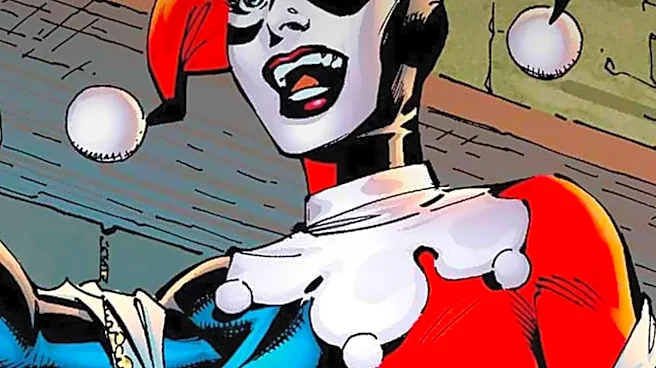
When Harley Quinn first tumbled into our lives in 1992 on 'Batman: The Animated Series', her look was as clear as her role. Created by Paul Dini and Bruce Timm, she was clad in a full-body red-and-black jester jumpsuit, complete with a floppy hood and a white
collar. This initial design, inspired by a dream sequence in the soap opera 'Days of Our Lives' featuring actress Arleen Sorkin in a jester outfit, defined Harley as an extension of the Joker. She was his court jester, a playful but subservient figure whose identity was entirely wrapped up in her devotion to her 'Puddin'. The costume was practical for animation and desexualized, emphasizing her role as a comic foil rather than an independent threat. For nearly two decades, this was the definitive Harley, a symbol of her tragic, all-consuming attachment.
A Grittier Look for a Darker Era
The late 2000s and early 2010s saw a major shift. The 'Batman: Arkham' video game series and DC's 'New 52' comic reboot introduced a grittier, more dangerous Harley, and her wardrobe followed suit. The jumpsuit was gone, replaced by corsets, revealing tops, and tight pants, while keeping the signature red-and-black palette. The 'New 52' went a step further, bleaching her skin like the Joker's and giving her mismatched red and blue (or black) pigtails, a look that would become a new staple. This change reflected a broader trend in comics toward darker, more 'realistic' aesthetics. It also marked a move to sexualize the character, a choice that proved divisive but successfully repositioned her as a more formidable and unstable villain in her own right, separate from her animated origins.
Hollywood's Icon: The Suicide Squad Effect
Margot Robbie's live-action debut in 'Suicide Squad' (2016) catapulted Harley's status from fan-favorite to global phenomenon. Her 'Daddy's Lil Monster' t-shirt, tiny hot pants, and satin bomber jacket became an instant, widely-copied Halloween costume. Costume designer Kate Hawley explained the look was meant to reflect a sense of ownership over her own sexuality, not to please others. Despite criticism for its overt sexualization, the outfit became iconic. It was a DIY, punk-inspired look that screamed chaos and personality. Crucially, the jacket was emblazoned with 'Property of Joker', explicitly stating her narrative position at the time. This look, more than any other, cemented a new mainstream image for Harley: unpredictable, dangerous, and visually defined by her toxic relationship.
The Fantabulous Emancipation of Her Wardrobe
If 'Suicide Squad' showed a Harley owned, 'Birds of Prey' (2020) was about her breaking free. The film's full title, '...and the Fantabulous Emancipation of One Harley Quinn', was the thesis statement for her new closet. Costume designer Erin Benach was explicitly told not to simply continue the previous film's look. The 'Property of Joker' jacket was gone. Instead, Harley’s clothes were a celebration of her newfound freedom: a caution-tape jacket with streamer-like sleeves, gold overalls, and a pink crop top. The look was still chaotic and DIY, but the message was different. As Benach noted, this was Harley’s 'breakup' wardrobe—fun, expressive, and for herself. The clothes were brighter and more playful, reflecting a character who was rediscovering her own identity away from her abusive ex.
Reclaiming Her Own Story
Today, Harley's look across comics, film, and TV is a synthesis of her entire journey. In 'The Suicide Squad' (2021), she donned a practical, red-and-black leather combat suit that paid homage to her original colors while being suited for a soldier. She also wore a flowing red dress, which, while beautiful, was given to her by a captor, continuing the theme of her wardrobe reflecting her agency—or lack thereof. In recent comics, she has even reclaimed her original jester suit, not as a symbol of her subservience to the Joker, but as a professional 'uniform' for her work as a consultant psychologist to other villains. It’s the ultimate act of reinvention: taking the symbol of her trauma and making it a source of her own power and passion.