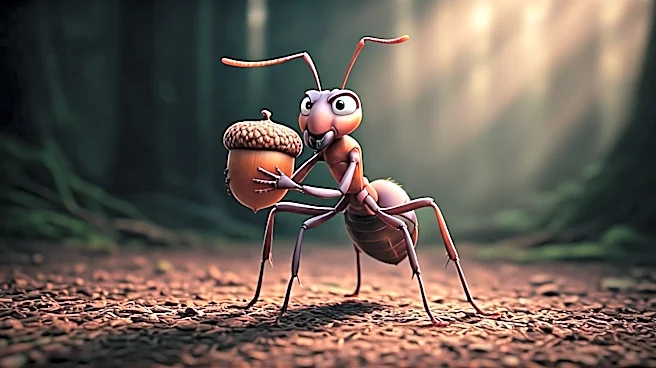








The Shadow of Toy Story
In 1995, Pixar changed filmmaking forever with *Toy Story*. But after the victory parades, a terrifying question loomed: Now what? The pressure to prove their debut wasn't a fluke was immense. The chosen follow-up was an idea director John Lasseter had
pitched years earlier, an animated twist on Aesop's fable "The Ant and the Grasshopper." The concept, initially called *Bugs*, would become *A Bug's Life*. From the start, the ambition was staggering. Where *Toy Story* featured a small cast of characters in a few contained rooms, *A Bug's Life* demanded a sprawling natural world. The team had to build an epic from a bug's-eye view, a challenge that went far beyond what they had accomplished with Woody and Buzz.
A Monumental Tech Leap
The core difficulty was technical. *Toy Story*'s world was made of plastic, wood, and other hard, defined surfaces—relatively easy for early CGI to render. *A Bug's Life* required something far more complex: organic life. The animators needed to create translucent leaves, glistening water droplets, detailed blades of grass, and characters with soft, flexible bodies. This wasn't just an artistic choice; it was a fundamental research and development problem. Then there was the crowd. The story's climax required a massive ant colony to rise up against the grasshoppers. Animating hundreds, even thousands, of individual characters at once was unheard of. The team had to write brand-new software to give each ant in the colony a degree of autonomy, so they wouldn't just look like a copy-pasted mob. Every step forward was a fight against the limits of technology, stretching the production timeline from a planned two years to nearly four.
The Betrayal That Sparked a War
While Pixar's tech wizards battled code, a human drama was unfolding that would define the film's production. The key player was Jeffrey Katzenberg, the famously aggressive head of Walt Disney Animation. John Lasseter had considered Katzenberg a mentor and, in confidence, had pitched him the idea for *Bugs*. In 1994, Katzenberg had a bitter falling out with Disney's CEO Michael Eisner and left the company. He quickly co-founded a rival studio, DreamWorks SKG, with Steven Spielberg and David Geffen. And he remembered Lasseter's pitch. In what is now a legendary tale of Hollywood backstabbing, Katzenberg launched production on a suspiciously similar computer-animated film about a neurotic ant who breaks from his colony to find his own identity. The film was titled *Antz*.
The 'Antz' Gambit
The news hit Pixar like a bomb. It wasn't just a similar idea; it was a direct threat. According to Steve Jobs, who was Pixar's CEO at the time, Katzenberg even offered to shut down *Antz* if Pixar would move *A Bug's Life* to avoid competing with DreamWorks' first animated film, *The Prince of Egypt*. When Jobs refused, Katzenberg allegedly put *Antz* on a hyper-accelerated production schedule with one goal: release it before *A Bug's Life* and steal its thunder. This move was seen as deeply personal. The DreamWorks team poached animators and rushed production, creating an intense, high-stakes race. The pressure on the *A Bug's Life* crew, already struggling with technical challenges, became unbearable. They weren't just making a movie anymore; they were fighting for their company's future against a well-funded rival led by a man who knew all their plans.