






Let Materials Tell the Story
One of the most potent tools in a designer's kit is materialism. You can tell an audience a lot about a culture by what it builds with. Human technology in sci-fi often relies on familiar elements: riveted steel, exposed wiring, and utilitarian plastics.
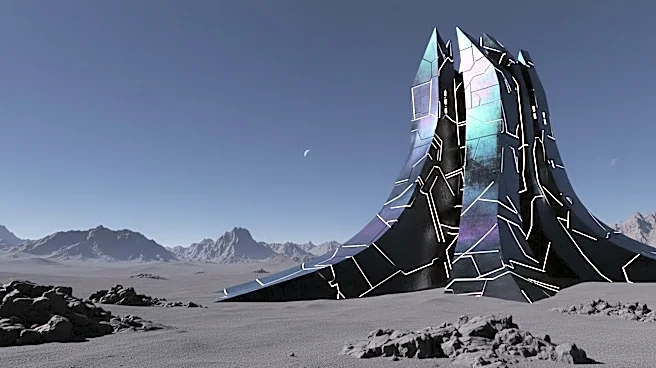
Eridian engineering, by contrast, is forged from impossible, almost geological materials. Their structures are often a seamless blend of iridescent, crystalline rock and pulsating energy. There are no bolts, no weld points—just pure, advanced form. This immediately signals that the builders are not human and their understanding of physics is far beyond our own. The materials feel ancient and elemental, as if they weren't manufactured in a factory but grown or willed into existence. When a player stumbles upon a shimmering, purple-hued Eridian gate, they don't need a tooltip to tell them it's alien; the very substance of it screams it.
Make the Function Obvious in the Form
The principle of "show, don't tell" is about clarity of purpose. An effective design communicates its function without a manual. Eridian artifacts excel at this. Their Vault Keys are ornate, but their purpose as a key is undeniable. Their portals possess an inviting, shimmering event horizon that practically begs to be stepped through. The architectural layouts of their ruins often guide the eye and the player toward a central point of interest, be it a terminal or a sealed chamber. This is environmental storytelling at its most fundamental. By embedding narrative information into the design itself, creators can ensure the audience understands what an object is for just by looking at it. The shapes used—whether it’s a focused energy beam or a sprawling containment field—are intuitive. This builds a world that feels logical and internally consistent, even when its rules are alien to us.
Create a Unified Visual Language
To sell the idea of a cohesive, ancient civilization, there must be a consistent design DNA across everything they created. The Eridians have a distinct aesthetic that's present in their smallest artifacts, their towering architecture, and the glyphs they use for writing. This visual language is defined by sharp, angular lines, crystalline structures, and a recurring motif of flowing energy. Whether you're looking at a Guardian robot, a Vault entrance, or a simple stone slab, they all feel like they belong to the same creator. This consistency does more than just look cool; it builds a subconscious understanding in the audience. They learn to recognize Eridian influence at a glance. This creates a powerful narrative shorthand. The moment players see those specific geometric patterns and that signature purple glow, they know they've found something ancient, powerful, and important.
Show the Scars of Time
Nothing sells "ancient" better than age itself. A brand-new Eridian structure would be impressive, but a ruined one tells a much richer story. Production designers show the passage of millennia by showing how the environment has reclaimed the technology. Eridian ruins are often covered in alien flora, cracked and weathered by planetary conditions, or half-buried under rock and soil. This visual decay is a form of narrative. It silently communicates that these structures have stood for eons, witnessing the rise and fall of lesser species. It poses questions: Who built this? Where did they go? What cataclysm could have possibly damaged something so advanced? This technique turns a static piece of architecture into an active historical document, providing a sense of deep time and mystery that no line of dialogue ever could.
Use Light and Energy as a Signature
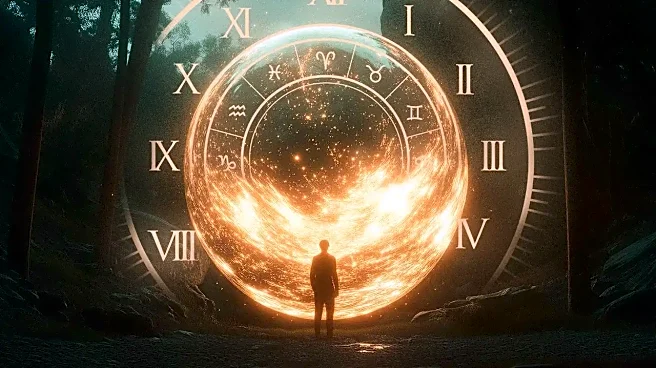
In a universe crowded with sci-fi concepts, a signature element can make a species instantly recognizable. For the Eridians, that signature is their unique use of light and energy. The vibrant, purple and blue glow that emanates from their technology is a constant visual marker. It's not just decorative; it communicates life and power. An inert Eridian device might be dark stone, but an active one pulses with this tell-tale energy. This serves multiple purposes. On a gameplay level, it signals interactivity. On a narrative level, it becomes the civilization's calling card. This use of light as a core component of their engineering suggests they mastered energy in a way that goes beyond simple power generation; it's a fundamental part of their existence and their aesthetic, as integral as stone or metal.