






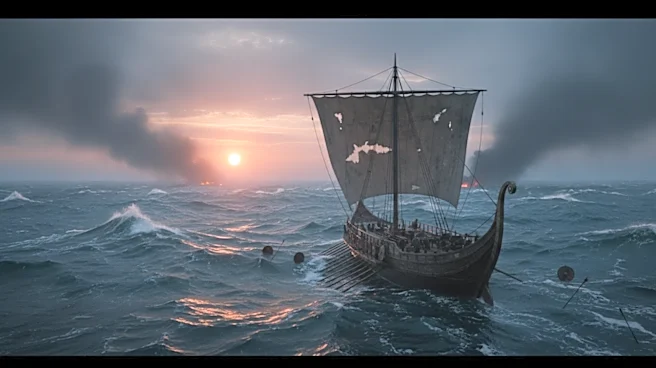

The Blueprint: Homer's Original Epic
Before we get to the adaptations, let’s remember the original. Composed around the 8th century BC, The Odyssey tells the story of Odysseus, king of Ithaca, and his ten-year struggle to return home after the Trojan War. It’s a foundational text of Western
literature for a reason. His journey is a gauntlet of mythical trials: he outsmarts the monstrous, one-eyed Cyclops, resists the hypnotic song of the Sirens, and navigates the treacherous strait between two sea monsters. Meanwhile, his wife, Penelope, fends off a horde of arrogant suitors, and his son, Telemachus, comes of age searching for his lost father. The story is the quintessential hero’s journey, a powerful mix of adventure, divine intervention, and the deep-seated human longing for home—a theme the Greeks called nostos.
The Modernist Maze: James Joyce's Ulysses
Flash forward to 1922. Irish writer James Joyce takes Homer's sprawling, decade-long epic and condenses its structure into a single day in Dublin: June 16, 1904. His novel, Ulysses, is a landmark of modernist literature, and its genius lies in its deep, complex parallel to The Odyssey. The wandering hero Odysseus is reborn as Leopold Bloom, a middle-aged Jewish advertising canvasser. His journey isn't across the Aegean Sea, but through the streets, pubs, and brothels of Dublin. The role of Odysseus's son, Telemachus, is filled by the young, brooding artist Stephen Dedalus, and the ever-faithful Penelope becomes Bloom's charismatic, unfaithful wife, Molly. Joyce used Homer’s mythic framework to give structure to the chaotic, fragmented experience of modern life, transforming an epic journey of gods and monsters into an internal, psychological odyssey.
The Southern Satire: O Brother, Where Art Thou?
If Joyce's adaptation is a dense literary puzzle, the Coen Brothers' 2000 film is a folksy, sun-drenched romp. O Brother, Where Art Thou? loosely bases its story on Homer's epic but transposes it to 1930s Mississippi during the Great Depression. The film even opens with an invocation to the Muse, just like the poem. George Clooney stars as the silver-tongued Ulysses Everett McGill, an escaped convict trying to get back to his wife, Penny (Penelope), before she marries another man. Along with his fellow escapees, he encounters a series of characters that directly echo Homer's work: a one-eyed, brutish Bible salesman named Big Dan Teague stands in for the Cyclops; three seductive washerwomen whose song lulls the men into a stupor are the Sirens; and the relentless Sheriff Cooley acts as a stand-in for the sea god Poseidon, constantly thwarting our hero's journey home. Though the Coens famously admitted to never having read the epic, they absorbed its structure through cultural osmosis, creating a brilliant satire that trades Greek mythology for American folklore and bluegrass music.
The Extended Family Tree
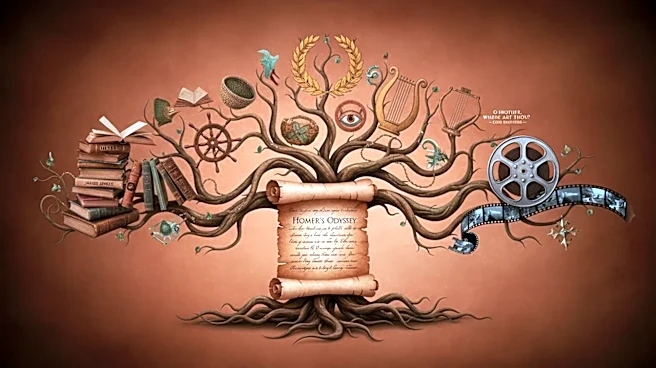
The influence of The Odyssey doesn’t stop there. The story's DNA can be found across genres and mediums. Charles Frazier’s novel Cold Mountain tells the story of a Confederate soldier’s perilous journey home to his beloved at the end of the Civil War, hitting many of the same narrative beats. Margaret Atwood's novel The Penelopiad retells the story from the perspective of Penelope and her twelve murdered maids, giving a voice to the epic’s female characters. Even Stanley Kubrick’s sci-fi masterpiece, 2001: A Space Odyssey, shares thematic DNA with the ancient poem. Its title is a direct nod, framing astronaut David Bowman’s journey into the unknown as a modern epic, with the mysterious monoliths acting like the intervening gods of Greek myth and Bowman himself as a new kind of Odysseus, pushing the boundaries of human experience.