



The Director and His Vision
Every great auteur story starts with an origin. For Pasquale Rotella, it wasn’t a film school; it was the underground rave scene of 1990s Los Angeles. Long before Insomniac Events became a Live Nation-backed behemoth, Rotella was a promoter driven by
a simple, powerful idea: creating temporary worlds of radical acceptance and sensory wonder. This philosophy, crystallized in the mantra PLUR (Peace, Love,Unity, Respect), isn't just marketing fluff; it's the core thematic concern of his life's work. Like a director returning to the same motifs, Rotella’s obsession is with crafting an environment where attendees, whom he calls “Headliners,” are the main characters. His personal history isn’t just backstory; it’s the foundational script for the massive, multi-day production that is EDC.
Building the World of EDC
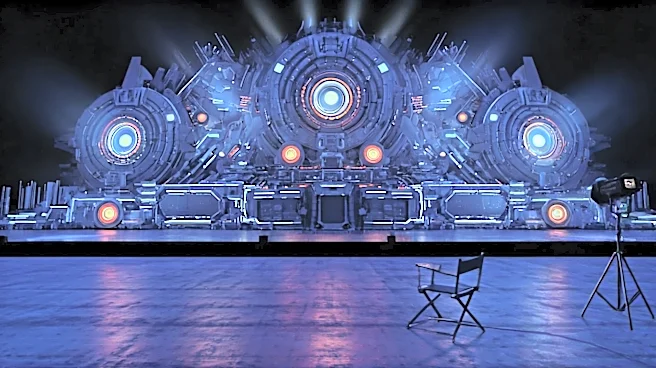
If EDC Las Vegas is Rotella’s magnum opus, the Las Vegas Motor Speedway is his soundstage. Auteur directors are known for their meticulous world-building, and Rotella’s approach is no different. The festival grounds are a masterclass in production design. Each stage, from the sprawling, animatronic kineticFIELD to the hardstyle-focused wasteland-themed stage, functions as a distinct set piece within a larger cinematic universe. These aren’t just platforms for DJs; they are elaborate, narrative-driven environments. Roaming troupes of performers in fantastical costumes, interactive art installations that glow and breathe, and the nightly fireworks displays are his equivalent of intricate cinematography and special effects. It's a consistent aesthetic choice: an overwhelming, joyful, and slightly surreal visual language that is unmistakably his. You don't just hear an Insomniac event; you see and feel it.
The Soundtrack as Story
An auteur’s control extends to the score, and at EDC, the music is the central pillar. While some might see a lineup featuring hundreds of DJs as a chaotic grab bag, in Rotella’s world, it’s a carefully curated soundtrack. The festival’s embrace of a wide spectrum of electronic music—from mainstream house and trance to niche genres like drum & bass and happy hardcore—is a deliberate choice. It reflects his own journey as a fan and his belief in the entire culture, not just its most commercially viable parts. He champions rising artists alongside global superstars, creating a narrative of the genre's past, present, and future. By giving each sub-genre its own dedicated stage and environment, he isn’t just booking talent; he’s telling a sprawling, epic story about the diversity and unity within electronic music. It’s his directorial choice to ensure every fan finds their scene.
The Limits of the Theory
Of course, the analogy has its limits. A film is a fixed object, consumed passively. A festival is a living, breathing organism co-created by hundreds of thousands of people. Alfred Hitchcock didn’t have to worry about 150,000 ticket holders bringing their own creative energy (and sometimes, their own problems) to the set of *Psycho*. Rotella’s control, as absolute as it may seem, is ultimately surrendered to the Headliners. The entire experience hinges on their participation, their energy, and their willingness to buy into the PLUR philosophy. In this sense, he’s less of a dictatorial auteur and more of a collaborative creator who builds the playground and sets the rules, but relies on the audience to truly bring the story to life. His film is an interactive one, where the audience is not just a viewer, but the entire cast.