




Counting Up vs. Counting Down
The most jarring difference for any NBA fan is the most basic: a soccer clock counts up, while a basketball clock counts down. An NBA game is four 12-minute quarters. A soccer match is two 45-minute halves. But the biggest difference isn't the direction
of the numbers; it's that the soccer clock *never stops*. Fouls, out-of-bounds balls, substitutions, injuries—the clock keeps ticking towards 45:00. This is the fundamental concept you have to accept. While an NBA game freezes time for every whistle, creating a predictable 48 minutes of *play time*, a soccer match embraces uninterrupted flow. The game is designed to be in constant motion, and the clock reflects that philosophy.
The Mystery of 'Stoppage Time,' Solved
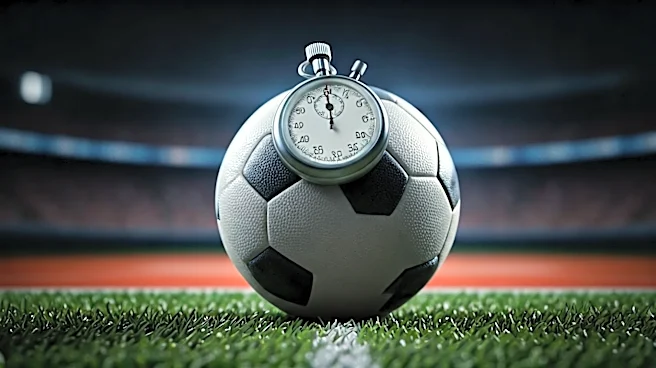
So if the clock never stops, how do they account for all those delays? Welcome to stoppage time, officially called “additional time.” Think of it like this: in the NBA, when a foul is called, the clock stops. In soccer, the referee mentally hits a stopwatch. He keeps a running tab of time lost to major delays: injuries, substitutions, video reviews (VAR), and even excessive goal celebrations or time-wasting tactics. At the end of each 45-minute half, the fourth official holds up a board showing the *minimum* amount of extra time the referee has calculated. This is why a half ends not at 45:00, but at 45:00 plus whatever the board says—often more, if there are delays during the stoppage time itself. It’s not arbitrary; it's the game’s way of paying back the time that was stolen from the flow.
From Precision to Discretion
The NBA clock is a model of precision. A tenth of a second can be the difference between a game-winning buzzer-beater and a heartbreaking late shot. Every whistle instantly halts the countdown, giving coaches precise windows for timeouts and strategic plays. Soccer trades that precision for human judgment. The referee is the sole arbiter of time. While the fourth official suggests the added time, the head referee’s whistle is what actually ends the half. There is no buzzer. He or she can end the game in the middle of an attack if the allotted time is up, or let a promising play continue for a few extra seconds. This injects a dose of human drama and controversy that the hyper-regulated NBA clock avoids. It’s less about a perfect calculation and more about the referee's feel for the game.
The Strategic Impact of the Clock
This philosophical divide creates two completely different end-game scenarios. The final two minutes of a close NBA game can take 20 real-world minutes, filled with a chess match of intentional fouls, timeouts, and carefully drawn-up plays. Teams can directly control the clock to their advantage. In soccer, that control is an illusion. A team leading in the 88th minute can't call a timeout. They can't stop the clock by fouling. Their only recourse is to engage in the “dark arts” of time-wasting—faking an injury, taking forever on a throw-in—hoping to run out the clock before the other team can score. But this is a dangerous game, as the referee is simply adding all that wasted time to his mental stopwatch, potentially giving the trailing team an even bigger window to find an equalizer in stoppage time. Instead of the NBA's controlled chaos, soccer's ending is a frantic, unpredictable scramble against a clock you can't see.