





For decades, Oliver Stone has been American cinema’s chief political agitator. His films are confrontational, stylistically aggressive, and obsessed with power, conspiracy, and historical trauma. But his unique spirit lives on in other filmmakers.
1. Adam McKay
Once
known for broad comedies, Adam McKay pivoted hard into Stone’s territory. With films like 'The Big Short' and 'Vice,' McKay adopted a similarly aggressive, in-your-face style to dissect complex political and financial corruption. His use of fourth-wall breaks, jarring edits, and cynical humor to explain infuriating truths feels like a direct evolution of Stone’s polemical approach. Where Stone used a dizzying montage in 'JFK' to overwhelm you with 'facts,' McKay uses celebrity cameos to explain subprime mortgages, achieving the same goal: making the complex and corrupt accessible and maddening. He shares Stone's palpable anger and his desire to use cinema as a forensic tool.
2. Kathryn Bigelow
While her style is less bombastic, Kathryn Bigelow shares Stone’s obsession with the visceral reality and moral costs of American power. Films like 'The Hurt Locker' and 'Zero Dark Thirty' plunge the viewer directly into the chaos of modern warfare and intelligence operations with a 'you-are-there' intensity. Like Stone’s 'Platoon,' her films are less about grand political statements and more about the psychological toll on the individuals executing policy. She forces audiences to inhabit morally ambiguous spaces, refusing easy answers. This focus on procedural realism and the brutal consequences of geopolitical conflict creates a powerful echo of Stone's own Vietnam-era obsessions.
3. Spike Lee
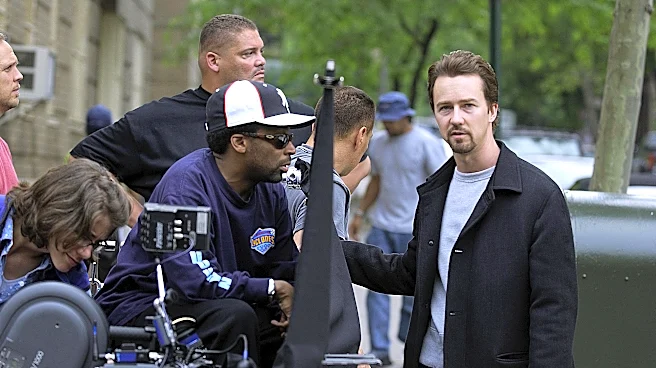
A contemporary of Stone, Spike Lee has a body of work that is just as, if not more, politically confrontational. From 'Do the Right Thing' to 'BlacKkKlansman,' Lee’s films are stylistically bold, unapologetically argumentative, and deeply invested in dissecting America's racial and historical fault lines. Like Stone, Lee uses his camera as both a mirror and a weapon, employing a kinetic style to challenge audiences and provoke debate. His work is a constant interrogation of American identity and injustice, tackling systemic issues with the same fierce urgency that Stone applied to the Vietnam War and the Kennedy assassination.
4. Aaron Sorkin
Aaron Sorkin, especially in his work as a director on films like 'The Trial of the Chicago 7,' reveals a deep kinship with Oliver Stone’s fixation on recent American history and the corridors of power. While Sorkin’s primary weapon is dialogue, his stories are packed with ideological clashes, morally compromised heroes, and a fascination with how history is shaped and manipulated. He shares Stone’s interest in the 'great man' narrative and the dramatic friction between idealism and pragmatism. 'The Trial of the Chicago 7' feels like a Sorkin-penned, Stone-directed movie that never was, blending courtroom drama with flashbacks of protest and state_sanctioned violence.
5. Alex Gibney
If Oliver Stone’s spirit lives in documentary film, it's in the work of Alex Gibney. He is a cinematic investigator, using his films to prosecute powerful and corrupt institutions. Whether tackling corporate fraud in 'Enron: The Smartest Guys in the Room' or institutional abuse in 'Going Clear: Scientology and the Prison of Belief,' Gibney exhibits a relentless, forensic approach. His films are dense with information and driven by a moral outrage that aims to expose secrets and hold power to account. This prosecutorial zeal and focus on systemic corruption make him the nonfiction heir to the director who gave us the ultimate conspiracy investigation, 'JFK'.
6. Paolo Sorrentino
Italian director Paolo Sorrentino might seem like an outlier, but his extravagant, operatic style is a perfect match for Stone's more baroque tendencies. His political biopic 'Il Divo' examines the dark, conspiratorial career of Italian Prime Minister Giulio Andreotti with a hyperstlyized, almost surreal visual language. Sorrentino uses swooping cameras, anachronistic music, and grotesque characterizations to capture the rot at the heart of power—much like Stone did in 'Nixon' or 'Natural Born Killers'. This willingness to blend satire, horror, and high art to critique the powerful reveals a sensibility that is deeply in sync with Stone's own audacious vision.