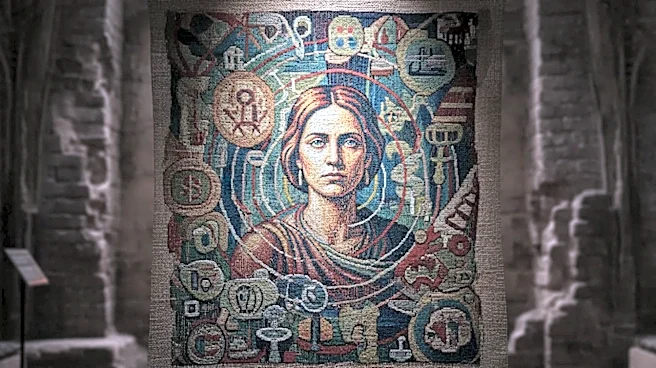










The Ancient Ideal: A Paragon of Fidelity
In the world of ancient Greece, a woman’s virtue was paramount, and Penelope was its poster child. For twenty years, she waited for her husband Odysseus to return from the Trojan War, fending off more than a hundred aggressive suitors who overran her palace.
To an ancient audience, her loyalty wasn’t just romantic; it was a fundamental duty. She was the guardian of the oikos—the household, estate, and lineage. Her steadfastness preserved not only her husband’s property but also his honor and the legitimacy of their son, Telemachus. Ancient writers often contrasted her with her cousin Clytemnestra, who murdered her husband Agamemnon upon his return from Troy. Penelope was celebrated as the gold standard of wifely devotion in a deeply patriarchal society that feared female autonomy. Her tears and pining were seen as proof of her love and virtue, the proper emotional response for a wife whose husband was lost.
The Cunning Strategist Hiding in Plain Sight
While ancient audiences praised her fidelity, they also recognized her intelligence, a quality that modern readers have seized upon as evidence of her agency. Her most famous trick—weaving a burial shroud for her father-in-law by day and unraveling it each night—was an act of brilliant deception that held her suitors at bay for three years. This wasn't just passive waiting; it was an active, high-stakes strategy to control her own fate and protect her kingdom. She also cleverly manipulated the suitors, coaxing expensive gifts from them to replenish the very estate they were draining. Finally, her decision to test the returned Odysseus, refusing to accept him until he proved his identity by revealing the secret of their unmovable bed, shows a mind as sharp and cautious as his. Where ancient listeners might have seen these as clever tools in service of loyalty, modern eyes see a master manipulator playing a long game for survival.
The Modern Feminist Reading: Agency and Resistance
For much of literary history, Penelope was a supporting character in her husband's epic. But feminist criticism has reframed her as the protagonist of her own story. From this perspective, Penelope is a woman navigating an oppressive patriarchal system with the limited tools available to her. Her waiting is not passive submission but a form of resistance. She uses the stereotype of the grieving, weaving woman as a cover for her political maneuvering. This reinterpretation has been powerfully explored in contemporary fiction, most notably in Margaret Atwood’s 2005 novella, The Penelopiad. Atwood retells the story from Penelope’s perspective in the afterlife, giving voice to her and her twelve maids who were executed upon Odysseus’s return. This revisionist take questions the original epic's narrative, focusing on the female experience and the brutal injustices glossed over in the heroic tale. Penelope becomes a self-aware, sometimes flawed, and deeply human character who is far more than just a symbol of patience.
A Psychological Portrait of Grief and Ambiguity
Today, we are also more likely to read Penelope through a psychological lens. Her twenty-year wait can be interpreted not just as an act of faith, but as a complex state of grief, trauma, and suspended identity. Was she truly convinced Odysseus would return, or was she trapped in an ambiguous state, unable to move forward or fully accept his death? Some readings suggest her actions were driven by a deep-seated need to maintain control in a chaotic world. Her meticulous deceptions and careful tests are the actions of someone who trusts no one. Even her final test of Odysseus can be seen as the act of a woman who has been alone for so long that she is wary of letting anyone, even her long-lost husband, back into her life without absolute certainty. This view adds a layer of emotional realism to her character, making her less of an archetype and more of a relatable human being grappling with profound loss and uncertainty.