






First, Forget Everything You Know
The biggest mental hurdle for an NFL fan watching soccer is the clock. In American football, time is a weapon. It’s a finite resource to be managed, manipulated, and milked. The game is a series of controlled bursts, with the clock stopping constantly
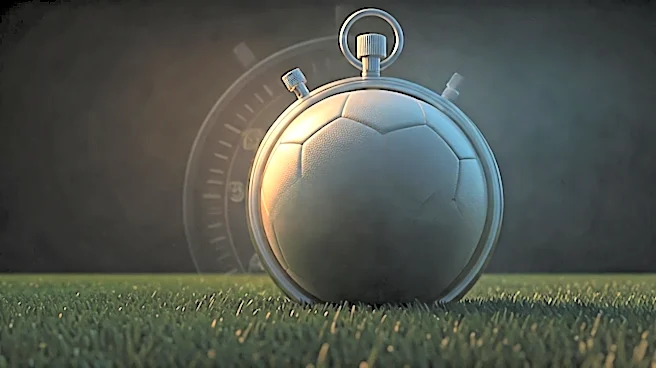
for incomplete passes, out-of-bounds plays, and commercial breaks. Time is precise and segmented. Soccer operates on a completely different philosophy: flow. The game is designed to be a continuous, fluid contest with minimal interruptions. The clock is not a strategic tool for coaches but a general marker of the game's progression. It runs up, not down, from 0:00 to 90:00. And with very few exceptions, it never, ever stops. Not for a foul, not for a goal, not for the ball going out of play. This isn't a glitch; it's the entire point. The goal is to keep the rhythm of the game intact, creating a different kind of drama that builds over long stretches rather than in short, explosive increments.
The Mystery of Stoppage Time
This is the big one. If the clock never stops, how do they account for all the time wasted on injuries, substitutions, and diva-level flopping? Welcome to “stoppage time” (or “added time”). It’s the closest thing soccer has to the NFL’s clock management, but it’s an art, not a science. Throughout each 45-minute half, the fourth official on the sideline keeps a separate, informal tally of time lost. Think of it like this: every major stoppage—an injury, a video review (VAR), a substitution, or excessive time-wasting—is noted. At the end of the 45 minutes, the head referee decides how much of that lost time to add back. The fourth official then holds up a board showing the *minimum* number of extra minutes to be played. It could be two minutes, it could be ten. The key word is *minimum*. The game ends only when the referee decides to blow the final whistle, which can happen even after the announced stoppage time has expired. It’s intentionally subjective to discourage teams from thinking they can run out the clock precisely.
No Timeouts, No Commercials, No Mercy
Imagine an NFL coach unable to call a timeout to stop a drive or ice a kicker. That’s the reality in soccer. There are no coach-called timeouts. Once the whistle blows to start the half, the players are largely on their own. The only significant breaks are at halftime. This places an immense burden on players to manage the game themselves—to recognize when to slow things down, when to speed up, and how to communicate adjustments on the fly. It also means there are no built-in TV timeouts every few plays. A professional soccer match is broadcast in two near-uninterrupted 45-minute blocks, a viewing experience that can feel both refreshing and jarring to an American audience accustomed to frequent ad breaks. Substitutions are also far more restrictive. In the NFL, you have specialized units and near-constant player rotation. In most professional soccer leagues, a manager gets just five substitutions for the entire game, and once a player is taken out, they can’t come back in. Every substitution is a massive strategic decision with permanent consequences.
How the Game Actually Ends
In the NFL, the end is absolute. When the clock hits 0:00, the game is over (unless a play is still in progress). You can have a dramatic, last-second field goal or a Hail Mary as time expires. Soccer’s ending is far more anticlimactic and, to the uninitiated, deeply unfair. The referee can, and often does, blow the final whistle while a team is in the middle of a promising attack. Why? Because the clock is not the final authority; the referee is. If the ref decided three minutes of stoppage time were warranted, they will aim to end the game around that mark, regardless of what’s happening on the field. The idea is that both teams knew the approximate window, and the attacking team simply ran out of time. It prevents a losing team from just launching desperate, endless attacks well past the allotted time. It’s a brutal, unceremonious end that prioritizes the referee's control over the narrative of a Hollywood finish.