









The 'Hand of God' Becomes a Foul
The year is 1986. Argentina and England are locked in a tense World Cup quarterfinal, freighted with political tension from the recent Falklands War. Six minutes into the second half, a looping ball descends in the English penalty area. Argentine superstar
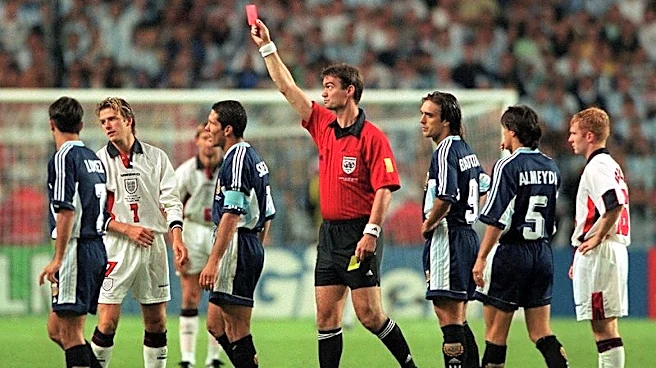
Diego Maradona, all five-foot-five of him, leaps with England's six-foot-one goalkeeper, Peter Shilton, and punches the ball into the net. The referee, with no clear view, allows the goal, which Maradona would later famously attribute to "the hand of God." Four minutes later, Maradona scores the "Goal of the Century," a stunning solo run that seals a 2-1 victory. With VAR, the handball is an open-and-shut case. The goal is immediately disallowed, and Maradona is shown a yellow card for unsportsmanlike conduct. Does England, now playing against a 10-man Argentina if he gets a second yellow, go on to win the match? Does Argentina, without the momentum from the illegitimate goal, still find a way to win the World Cup? Maradona's legacy as a flawed genius is cemented by this moment, but without it, the entire narrative of Mexico '86 changes.
England's 1966 'Ghost Goal' Vanishes
For England, 1966 is a hallowed year—the only time the nation has lifted the World Cup trophy. The final against West Germany at Wembley was deadlocked 2-2 in extra time. In the 101st minute, English striker Geoff Hurst fired a shot that struck the underside of the crossbar and bounced down onto the goal line before being cleared. The Swiss referee consulted his linesman from the Soviet Union, who insisted the ball had crossed the line. The goal was given, England went on to win 4-2, and a national legend was born. To this day, Germans contend it was not a goal, and computer-aided analysis has often supported their claim. In a VAR-equipped world, a definitive goal-line technology review would have settled the matter in seconds. Had the call been "no goal," the match remains 2-2. West Germany, who were arguably the stronger team in moments of extra time, might have gone on to win. England's lone star on their jersey could very well have been a ghost of a different kind—one that never materialized.
Lampard's Goal That Wasn't, Is
The 2010 World Cup in South Africa provided one of the most glaring arguments for implementing technology. In a round-of-16 clash, England trailed Germany 2-1 when midfielder Frank Lampard launched a brilliant long-range shot. The ball struck the crossbar, bounced a full yard over the goal line, and spun back out. Incredibly, neither the referee nor the linesman awarded the goal, leaving players and millions of viewers stunned. The game would have been tied 2-2, completely shifting the momentum. Instead, a demoralized England fell apart in the second half, losing 4-1. With VAR, the goal is awarded instantly. The psychological blow Germany would have suffered from surrendering a two-goal lead could have changed everything. This single, egregious error is widely seen as the tipping point that forced a reluctant FIFA to finally embrace goal-line technology, the precursor to full VAR.
Ireland's Ticket to South Africa
While not in the World Cup finals itself, one of the most infamous handballs in modern history denied a nation its place at the tournament. In November 2009, France and the Republic of Ireland were in extra time of a playoff match to qualify for the 2010 World Cup. French superstar Thierry Henry blatantly controlled the ball with his hand—twice—before crossing it to William Gallas for the decisive goal. The referee missed it, France won the tie 2-1 on aggregate, and Ireland was eliminated. The injustice sparked global outrage and calls for a replay, which were denied. With VAR, Henry's handball is instantly spotted. The goal is chalked off, Henry is booked, and the play is dead. The match would have likely proceeded to a penalty shootout. Given France's subsequent implosion at the 2010 World Cup, where they crashed out in the group stage amidst team turmoil, history might have been kinder to a spirited Irish side taking their place.