









The Allure of the Instant Future
When tasked with creating a futuristic or alien look, the impulse is to reach for something that screams 'technology'. For decades, that has meant shiny, metallic fabric. The most common culprit is lamé, a textile with a thin metallic coating that offers
an immediate, eye-catching shimmer. For amateur cosplayers and even some lower-budget productions, it feels like a perfect shortcut. It's relatively cheap, widely available, and in person, it looks like liquid metal. The appeal is obvious: you can sew a spacesuit or a piece of armor that, at first glance, appears convincingly non-terrestrial. It seems to solve the complex problem of mimicking metal with a simple bolt of fabric. Unfortunately, this 'too good to be true' solution has a massive hidden drawback that only becomes apparent under the unforgiving eye of a camera.
Why Shiny Fabric Fails on Camera
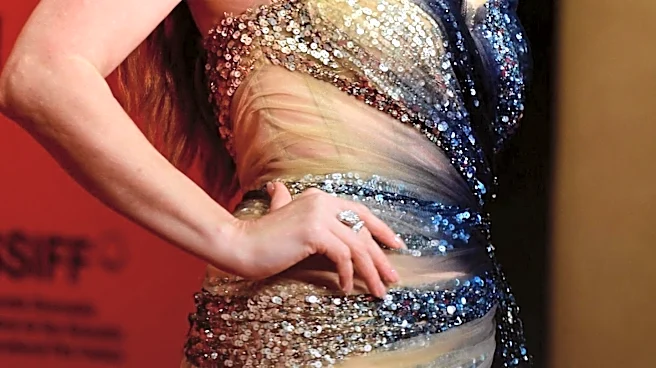
The problem with fabrics like lamé isn't how they look to the naked eye, but how they interact with light. Professional lighting, whether on a film set or at a photoshoot, is intense and controlled. When that light hits a smooth, highly reflective surface like metallic foil fabric, it doesn't scatter or reveal texture—it bounces back directly into the camera lens. This creates what photographers call 'hot spots' or 'specular highlights'. Instead of seeing the subtle curves, seams, and details of the costume, the viewer just sees a flat, white glare. All the form and dimension of the piece are completely 'flattened' and lost. Shadows, which are crucial for creating a sense of depth and shape, are obliterated in a sea of uncontrolled reflection. The costume stops looking like a three-dimensional object and instead resembles a cheap, crumpled piece of aluminum foil. The very quality that made it seem futuristic—its shine—becomes its greatest liability on screen.
The Professional's Secret: Creating Texture and Dimension
So if not metallic fabric, how do Hollywood costume designers create the stunningly realistic armor seen in productions like 'The Mandalorian' or the functional gear in 'Dune'? The answer is an illusion built from layers of texture and masterful painting. Professionals start with a non-reflective base material, often something like EVA foam, 3D-printed plastics like ABS, or even leather. These materials can be cut, heated, and molded into complex shapes. Crucially, they have a matte surface that provides a perfect canvas. The 'metal' look is then meticulously painted on. This isn't a simple coat of silver spray paint. Artists use multiple shades of metallic and non-metallic paints to create artificial highlights and shadows. They add weathering with washes of black and brown to simulate dirt and oil, and create scratches and dents to tell a story of use and abuse. This painstaking process fools the eye into seeing the weight, texture, and history of real metal, something a single, flatly reflective fabric can never achieve.
Case Studies in Faux-Metal Mastery
Once you know what to look for, you'll see this technique everywhere. The iconic beskar armor from 'The Mandalorian' is a prime example. While it appears to be forged from an indestructible space-age steel, the actual props are typically made from painted urethane, ABS plastic, or fiberglass. The incredible realism comes from the paint job, which uses layers of chrome-effect paint, subtle toning, and physical weathering to mimic the way real, worn metal would catch the light. Similarly, the Fremen stillsuits in the 'Dune' films needed to look functional and lived-in, not like party costumes. Designers used a combination of fabrics, custom-molded foam, and rubber tubing, all expertly painted and weathered to suggest a complex life-support system that has endured the harsh desert environment of Arrakis. In both cases, the believability comes not from an inherently 'metallic' material, but from artistry that fakes the physics of light on a textured surface.