




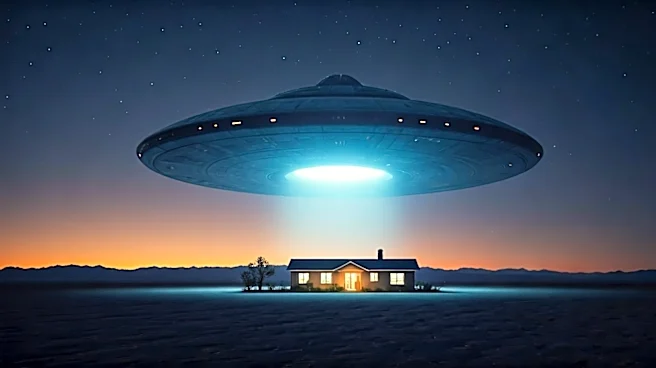
The Gospel of Wonder
For decades, Steven Spielberg was America’s chief ambassador to the cosmos. His vision of extraterrestrial life wasn't one of conquest, but of connection. In Close Encounters of the Third Kind (1977), the aliens are mysterious but ultimately benevolent
artists, painting the sky with light and sound. The film’s tension comes not from the visitors, but from a paranoid government trying to suppress a beautiful truth. Richard Dreyfuss’s Roy Neary isn’t running from a threat; he’s running toward an obsession, a spiritual calling represented by a mountain of mashed potatoes. The aliens want to communicate, and humanity’s best and brightest want to listen. Five years later, E.T. the Extra-Terrestrial (1982) miniaturized this awe into a suburban fable. Here, the alien is a lost, gentle creature who wants nothing more than to phone home. The only villains are adults—faceless, jangling keys at their belts—who see this gentle soul as a specimen to be dissected. The film is a pure distillation of childhood innocence triumphing over cold, cynical authority. In both films, the message is clear: the universe is filled with potential friends, and the only thing holding us back is our own fear and lack of imagination.
When the Skies Turned Hostile
Then came 2005. The tripods rose from the earth, and the Spielbergian dream of cosmic friendship was incinerated by a heat-ray. War of the Worlds is the director’s great paradox. It’s an alien movie completely drained of wonder, a brutal, ground-level survival-horror story. There is no communication. There is no negotiation. The aliens are never personified, never understood. They are a natural disaster, as impersonal and destructive as a hurricane or an earthquake. They don’t want to talk; they want to liquidate. The film’s perspective is claustrophobically tight, locked on Tom Cruise’s deadbeat dad, Ray Ferrier, as he tries to shepherd his children through a collapsing society. We don’t see generals in a war room or scientists in a lab. We see panicked crowds, overturned ferries, and the quiet, terrifying emptiness after a wave of destruction. Spielberg, the master of awe, turned his camera away from the magnificent spaceship and focused instead on the terrified faces of the people running from its shadow.
A Post-9/11 Nightmare
So what changed? America did. War of the Worlds is arguably the most potent blockbuster to emerge from the shadow of September 11, 2001. Spielberg himself has acknowledged that the film was a direct response to the collective trauma of that day. The imagery is unmistakable: the dust-covered survivors wandering through the streets, the impromptu memorials of clothes and photos, the sudden, inexplicable violence falling from a clear blue sky. The film’s opening act, where an ordinary New Jersey day erupts into chaos, perfectly captures the feeling of a world where safety is an illusion. This wasn’t a story about understanding the “other”; it was about surviving an incomprehensible attack. The mistrust in the film isn't just directed at the aliens—it’s everywhere. Neighbors turn on each other for a working car. A desperate man, played by Tim Robbins, becomes as much a threat as the tripods outside. The government is absent, its authority vaporized along with its armies. This was Spielberg processing a new, terrifying American reality where the enemy was unknowable and the social contract felt terrifyingly fragile.
Finding Hope in the Rubble
Yet, even in this bleak landscape, the old Spielberg flickers. The core of War of the Worlds isn’t the alien invasion; it’s a father learning to protect his children. Ray Ferrier begins the film as a selfish, disconnected man and ends it as a true parent. His entire journey is about holding his family together when the world is tearing itself apart. While the grand, optimistic vision of Close Encounters is gone, it’s replaced by something smaller but just as profound: the primal, fierce love of a family. That, ultimately, is the solution to the paradox. Spielberg didn’t abandon his humanism; he stress-tested it. He took his most cherished theme—the strength of the family unit—and threw it into the worst-case scenario imaginable. In his earlier films, wonder was the catalyst for connection. In War of the Worlds, terror is. It’s a darker, more desperate vision, but it suggests that even when we can’t trust the world, the government, or our neighbors, the one thing we can trust is the bond between a parent and a child.