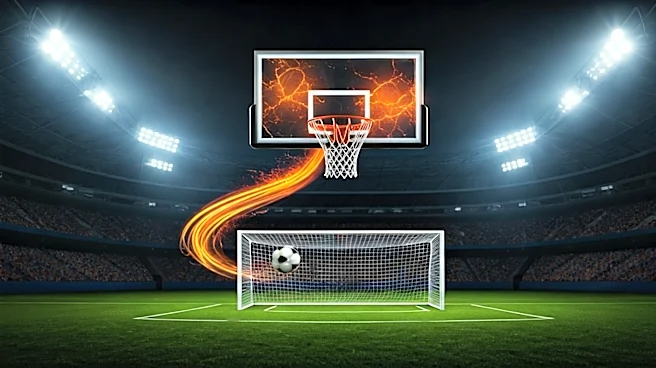







Basketball’s Gravity Problem
Stephen Curry didn't just break records; he broke the geometry of a basketball court. Before him, a defender felt safe once the offensive player was more than a few feet beyond the 23-foot, 9-inch three-point line. Curry erased that safety zone. The area
near the half-court logo, once a space to reset a play, became his launching pad. What makes Curry’s range so revolutionary isn't just the spectacle but the strategic terror it creates. Defenders are forced to pick him up 30 or even 35 feet from the basket, stretching the defense to its breaking point. This creates enormous gaps for his teammates to exploit. His ability to hit shots from 30-plus feet at an astonishingly high percentage—sometimes hovering around 40%, better than the league average from the regular three-point line—makes him a statistical anomaly and a defensive nightmare. This constant threat is often called “gravity,” as he pulls defenders toward him, fundamentally altering the court's spacing before he even decides to shoot.
The 30-Yard Screamer
In soccer, the long-range goal is an entirely different beast. A shot from outside the 18-yard penalty box, generally from 25 yards or more, is considered a long-range attempt. Unlike Curry's repeatable, near-scientific shooting form, a soccer shot from distance is often an act of audacious power or sublime technique. These moments are rarer and, in some ways, more dramatic. Players like Brazil's Juninho Pernambucano became legends for their mastery of the free-kick, using a “knuckleball” technique to make the ball dip and swerve unpredictably. Others, like Roberto Carlos, were known for generating impossible power and curve. These goals often involve beating a wall of defenders and a world-class goalkeeper, making them a low-probability, high-reward event. The psychological impact of a long-range “screamer” can shift the entire momentum of a match, energizing a team and its fans in an instant.
A Game of Percentages
Herein lies the fundamental difference: the math. Steph Curry's efficiency from deep is what makes him a generational talent. While his career three-point percentage is around 42%, his ability to maintain such a high clip from well beyond the arc is what's truly mind-bending. In contrast, scoring from outside the box in soccer is a statistically rare event. While 35-45% of shots in a game might come from that distance, the conversion rate is brutally low, often in the single digits. Some analyses suggest it can take more than 20 shots from outside the box to score a single goal. Even the world's most elite free-kick specialists, like James Ward-Prowse, have career conversion rates that are considered exceptional if they approach 15-20% on their attempts. This isn't a knock on soccer players; it's a testament to the sheer difficulty of scoring from distance against an 8-foot by 24-foot goal guarded by a professional keeper.
Skill vs. Unpredictability
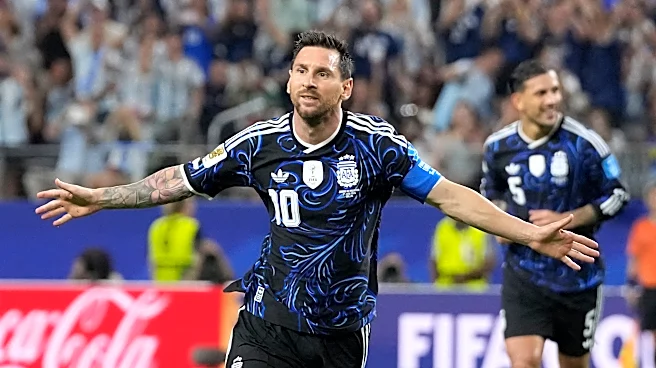
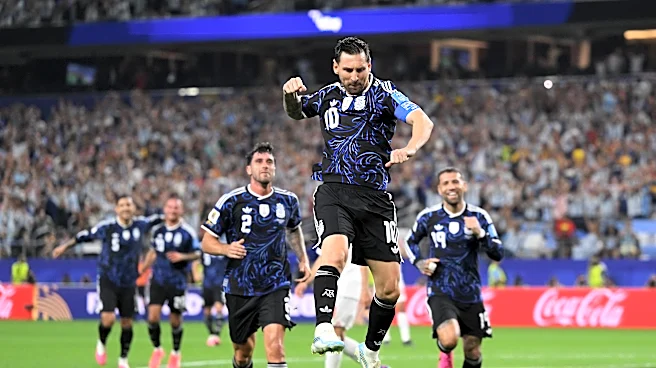
The skills, while both demanding elite-level mastery, are also fundamentally different. Curry's shot is the result of thousands of hours perfecting a consistent, repeatable motion. It's a closed-loop skill, often practiced in a controlled environment. A long-range shot in soccer, especially from open play, is often an improvised solution in a chaotic environment. It requires reading a dynamic game state, finding a sliver of space, and striking a moving ball with the perfect technique—whether it's a powerful, driven shot, a curling finesse effort, or a dipping volley. While a free kick offers a more controlled, static situation akin to Curry's set shot, it still involves more variables, including a defensive wall and the unpredictable flight of a soccer ball. Lionel Messi, perhaps the greatest modern example, has scored an incredible number of goals from outside the box, showcasing a blend of power, precision, and tactical intelligence that few can match.