








It Creates an Unforgettable Story
A perfect, predictable tournament is a boring tournament. If the top four seeds cruise to the semifinals and the favorite waltzes to a title, the event becomes a coronation, not a competition. The real drama, the stuff that gets etched into sports history,
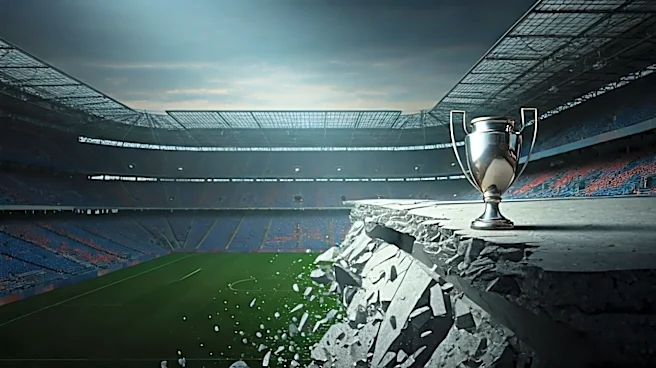
often comes from failure. A stunning collapse provides the narrative friction that every great story needs. It’s the plot twist you didn’t see coming, the moment that makes you gasp and text your friends, “Are you watching this?!” The rise of an underdog is a classic sports tale, but it’s only half the equation. For David to be a hero, Goliath must fall—and the more spectacularly he tumbles, the better the story. The collapse provides stakes, tension, and a villain, even if that villain is just the crushing weight of expectation. It transforms a series of games into a genuine epic.
The Human Drama is Irresistible
For 90 minutes, professional soccer players can seem like superhuman machines, executing flawless passes and scoring impossible goals. But a high-pressure tournament collapse peels back that veneer of perfection and reveals the fragile, flawed humanity underneath. It’s a real-time psychological drama playing out on a global stage.
Think of France’s 2010 World Cup team, which descended into open mutiny. The squad, riddled with ego and infighting, refused to train, and the coach read a letter from the players detailing their grievances to the world’s media. It was messy, embarrassing, and absolutely captivating. It wasn’t about tactics; it was about pride, pressure, and personality clashes. These are the moments that remind us that sports are not just about physical prowess but about mental fortitude. Seeing a team crack under that pressure is a deeply human and relatable phenomenon, even if it’s happening at an elite level.
It’s the Great Equalizer
Nothing reinforces the magic of a tournament like a powerhouse imploding. When a team loaded with global superstars fails to get out of its group, it sends a powerful message to every other nation: anything is possible. It injects a thrilling dose of uncertainty into the proceedings.
Take Spain at the 2014 World Cup. They were the defending World and European champions, the masters of the “tiki-taka” style that had dominated world soccer for six years. They were drawn into a group with the Netherlands, Chile, and Australia. They were humiliated 5-1 by the Dutch in their opening game and then eliminated after losing 2-0 to Chile. Just like that, an era was over. Their collapse blew the tournament wide open, creating a power vacuum and a sense that the throne was truly up for grabs. It keeps hope alive for the mid-tier teams and reminds fans that on any given day, history can be rewritten.
The Disasters Are as Memorable as the Triumphs
We remember the champions, but we never forget the collapses. In fact, the disastrous moments are often seared into our collective memory even more vividly. Ask any soccer fan about the 2014 World Cup, and they may struggle to recall every goal from the final. But they will absolutely remember where they were when host nation Brazil, the sentimental favorite, was systematically dismantled 7-1 by Germany in the semifinal.
It was a national trauma played out in real time, a scoreline so shocking it felt like a typo. That single game has become a cultural touchstone, a shorthand for total and complete annihilation. The same goes for Italy, the 2006 champions, finishing dead last in their group in 2010 without a single win. These aren't just footnotes; they are legendary chapters in the tournament's history. The triumphs provide the joy, but the collapses provide the awe, the shock, and the enduring cautionary tales that are told for generations.