






The Fall: A Red Card in Saint-Étienne
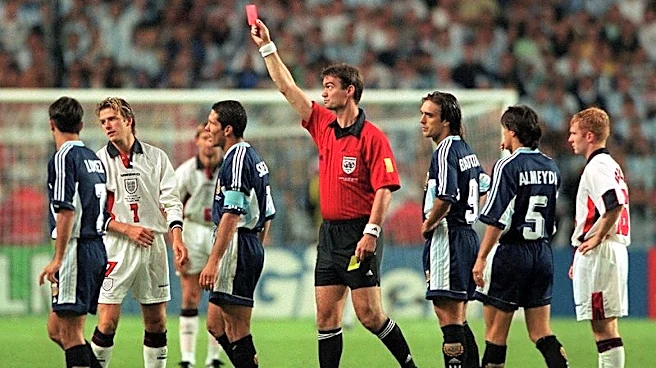
The first act begins on June 30, 1998. England is locked in a tense World Cup knockout match against its fiercest rival, Argentina. A 23-year-old David Beckham, already a star for his looks and celebrity romance as much as his talent, is on the field.
Early in the second half, Argentina’s Diego Simeone fouls Beckham, sending him to the turf. Simeone gives him a taunting pat on the back. Beckham, still on the ground, foolishly retaliates with a petulant flick of his leg, tripping the Argentine player. It wasn't violent, but it was enough. Simeone collapses theatrically, and the referee shows Beckham a red card. Down to 10 men, England eventually loses on penalties. A nation's dreams are dashed, and it needs someone to blame.
The Villain: Public Enemy Number One
The backlash was not just swift; it was brutal. Beckham was transformed overnight from the 'Golden Boy' of English football into a national pariah. Tabloid headlines screamed betrayal, labeling him immature and stupid. An effigy of him was hung from a lamppost outside a London pub. For the next few years, every time he stepped onto a pitch for his club, Manchester United, he was met with a chorus of boos and vitriol from opposing fans. He received death threats and bullets in the mail, forcing his parents to be placed under police watch. As he and his wife, Victoria, later recounted in a Netflix documentary, the constant abuse took a severe toll on his mental health, leading to what she described as clinical depression. It was the lowest point of his professional life, a public shaming that seemed impossible to escape.
The Climb: A Captain's Burden
But a redemption arc requires resilience. Backed by his club manager and teammates, Beckham channeled the hostility into fuel. He had arguably his best-ever season for Manchester United immediately following the World Cup, winning a historic treble of trophies in 1999. His performances were undeniable. By 2000, a new England manager, Sven-Göran Eriksson, not only brought him back into the fold but handed him the captain's armband. The villain was being recast as the leader, tasked with guiding his country to the next World Cup. He carried the responsibility with a relentless work ethic, running himself into the ground for the team that had once felt so betrayed by him.
The Redemption: One Kick Against Greece
The story's climax arrived on October 6, 2001. England needed at least a draw against Greece at home to automatically qualify for the 2002 World Cup. But with 92 minutes played, they were losing 2-1 and heading for a perilous playoff. Beckham, who had run tirelessly all game, had one last chance: a free kick 30 yards from goal. The entire stadium, and the nation watching at home, held its breath. He had taken several free kicks already in the game, but this was the last shot. He stepped up and curled the ball perfectly over the wall and into the top corner of the net. The stadium erupted. With a single, glorious kick, Beckham sent England to the World Cup and completed his transformation from scapegoat to savior.
The Sequel: Full Circle in Japan
If the goal against Greece was the climax, the 2002 World Cup provided the perfect epilogue. In a moment of pure sporting poetry, the tournament draw placed England in the same group as Argentina. On June 7, 2002, the two rivals met again. Just before halftime, England was awarded a penalty. The responsibility fell to the captain. Under immense pressure, Beckham stood over the ball, facing the team that had been the source of his darkest professional moment. He struck the penalty with ferocious power, rocketing it down the middle to score the only goal of the game. England won 1-0. The ghosts of 1998 were finally banished. The redemption arc was complete, not just with a moment of brilliance, but with a victory over the very rivals who had started his ordeal.