





Kim Jones
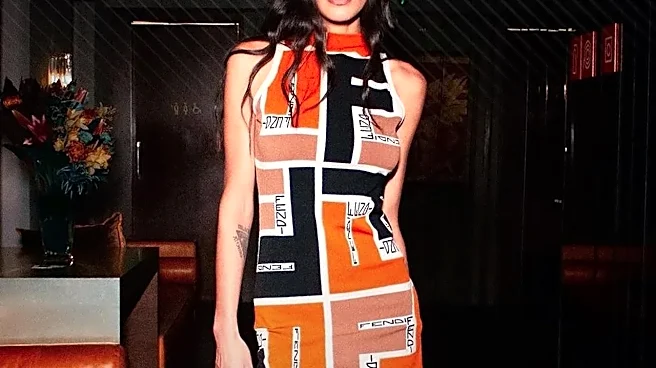
Let’s start with the most direct successor. As the current artistic director of couture and womenswear at Fendi, Kim Jones has the monumental task of following a legend. Instead of erasing the past, he thoughtfully builds upon it. Jones understands the codes
of the house that Karl built: the focus on incredible craftsmanship, the juxtaposition of sharp tailoring with fluid femininity, and a deep appreciation for Fendi's Roman roots. He reinterprets Lagerfeld's legacy for a new generation, often referencing archival prints and silhouettes with a fresh, modern sensibility. His work is less a tribute and more a continuation of the conversation, proving the Fendi DNA is still as potent as ever.
Miuccia Prada
While stylistically different, Miuccia Prada is perhaps Lagerfeld's closest peer in spirit. Both are masters of the high-low mix and possess an intellectual, often contrary, approach to fashion. Lagerfeld’s genius was making something as traditional as fur feel punk; Prada’s is making nylon luxurious and defining an entire aesthetic of 'ugly chic.' Both designers have a knack for subverting expectations and creating trends rather than following them. If you appreciated the wit and the intelligent questioning of taste that ran through Lagerfeld’s Fendi collections, you'll find a kindred spirit in Miuccia Prada's consistently challenging and thought-provoking work. She forces you to reconsider what you find beautiful.
Jonathan Anderson
If Lagerfeld's Fendi was about playful luxury, Jonathan Anderson is its surrealist heir. For both his own JW Anderson label and as creative director of Loewe, Anderson shares Karl's flair for the unexpected. Where Lagerfeld might have put a cartoonish monster on a handbag, Anderson will put a deflated balloon on a shoe. He champions a similar devotion to artisanal craft, pushing workshops to their limits to create objects that are both beautifully made and conceptually bizarre. It’s this shared love for turning fashion into a conversation piece—a blend of serious craftsmanship and a not-so-serious attitude—that connects Anderson's vision to the innovative spirit of Lagerfeld’s Fendi.
Glenn Martens
For those who loved the architectural and deconstructed elements of Lagerfeld’s designs, Glenn Martens is your man. At Y/Project and Diesel, Martens has become a master of twisting and re-engineering garments, turning a simple pair of jeans or a jacket into a complex, sculptural piece. This echoes how Lagerfeld would reinvent classic shapes, playing with volume, asymmetry, and trompe-l'oeil effects to create something entirely new. Martens shares Lagerfeld’s obsession with how clothes are constructed and, more importantly, how they can be reconstructed. His work is a continuous experiment in form and function, a trait that defined much of Karl's forward-thinking Fendi output.
Virgil Abloh's Legacy
Virgil Abloh, like Karl Lagerfeld, was a master collaborator and cultural synthesizer. His work at Off-White and Louis Vuitton redefined modern luxury by blending it with streetwear, music, and art—a formula Lagerfeld perfected decades earlier. The iconic double 'F' logo Lagerfeld created was meant to stand for 'Fun Furs,' a playful take on branding. Abloh’s use of quotation marks and zip-ties served a similar function: re-contextualizing the familiar and turning it into a status symbol. Both designers understood that a logo wasn't just a mark, but a piece of cultural language. Abloh's legacy lies in his ability to bridge worlds, a skill he shared with the Kaiser himself.