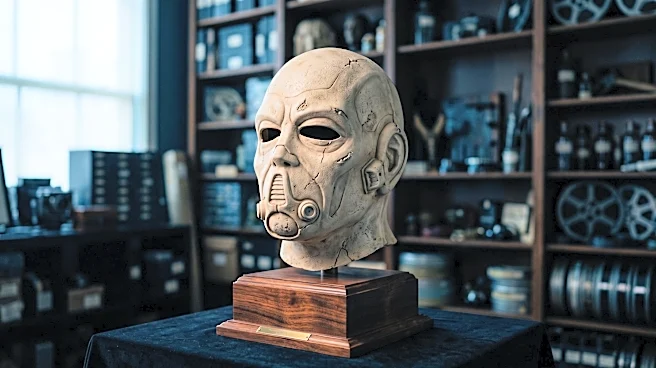







Dah-dun, dah-dun, dah-dun… You know it instantly. The chilling piano melody is as iconic as Michael Myers's mask. But how did director John Carpenter, faced with a tiny budget, create one of cinema's most terrifying themes from just a few notes?
Creativity Born From Constraint
In 1978,
'Halloween' was a scrappy independent film with a shoestring budget of around $300,000. An orchestral score, the standard for horror films aiming for prestige, was completely out of the question. After a screening for a studio executive without music fell flat—she reportedly said it wasn't scary—Carpenter knew he had to 'save it with the music'. Having composed scores for his previous, even lower-budget films, he took on the job himself. As he often joked, he was the 'fastest and cheapest' composer he could get. This DIY necessity forced a minimalist approach that would ultimately define the film's terrifying atmosphere.
A Rhythm Lesson from Dad
The theme's secret weapon isn't just the notes; it's the rhythm. The iconic melody is built on an unusual 5/4 time signature. Most Western music is in a predictable 4/4 time, but the five-beat pattern feels slightly off-kilter and unsettling, preventing the listener from ever feeling comfortable. Where did Carpenter get the idea? From his father. When he was 13, his father taught him how to play 5/4 time on a pair of bongo drums. That childhood lesson stuck with him and became the rhythmic foundation for the theme, which he transposed from bongos to piano, creating that relentlessly stalking pulse.
The Unsettling Genius of Simplicity
While the headline simplifies it to 'five notes,' the melody is a simple, repeating piano motif. The right-hand melody is often just a few notes, like C-sharp and F-sharp, with a dissonant half-step added at the end that creates a clash. This pattern, combined with the 5/4 rhythm, makes the music feel like an unstoppable machine—much like Michael Myers himself. Carpenter was heavily influenced by composers like Bernard Herrmann, who used simple, repetitive motifs to create immense tension in Alfred Hitchcock's films, most famously 'Psycho'. Carpenter applied the same logic: you don't need a complex orchestra to create fear. Sometimes, a few piercing notes are far more effective.
Three Days of Synthesized Terror
With the concept in place, the execution was astonishingly fast. Carpenter booked a Los Angeles studio and, with the help of synth programmer Dan Wyman, composed and recorded the entire score in just three days. Some accounts even suggest the main theme itself was written in about an hour. He worked blind, recording themes to a click track without syncing them to the picture, later cutting the music into the film where it felt right. Using the synthesizers of the era, he layered the simple piano line with deep, ominous bass tones and piercing string_like sounds to build a soundscape of dread. He wasn't a master of the technology—he'd tell Wyman the sound he wanted, and Wyman would dial it in on the complex machines.
The Sound of Inevitable Evil
The result is one of the most recognizable and influential pieces of film music ever created. The theme doesn't just accompany the horror; it becomes a character in its own right. It is the sound of pure, emotionless, and inevitable evil. Its minimalism has been praised by critics and studied by musicians, proving that sometimes the most powerful statements are the simplest. The music transformed a low_budget slasher into a horror landmark, demonstrating that with a clear vision and a dash of raw talent, a few notes can echo through cinema history for decades.