







An Engine for Claustrophobia
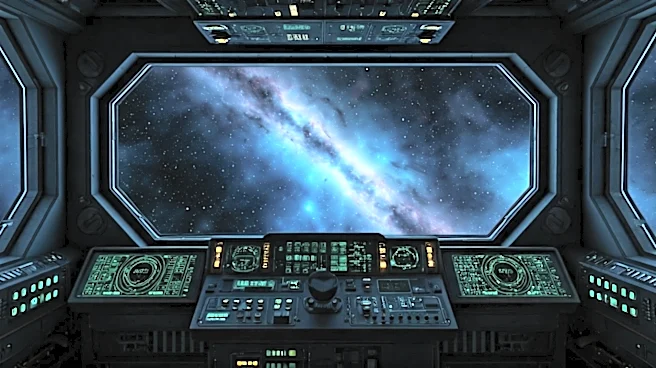
The most visceral use of a sky-less frame is to create a crushing sense of claustrophobia. Think of Ridley Scott’s “Alien.” We spend almost the entire film inside the winding, industrial corridors of the Nostromo, a commercial towing vessel that becomes
a tomb. The ceilings are low, the hallways are narrow, and steam vents obscure our view. The camera rarely, if ever, gazes out a viewport to the vast emptiness of space. The result is that we, like the crew, feel trapped. There is no escape, no open air, no “up.” The monster isn’t just the xenomorph; it’s the ship itself. The architecture of the set becomes a psychological prison. Neil Marshall took this to its logical extreme in “The Descent,” a horror film set entirely within an uncharted cave system. By design, there is no sky to show. The ceiling is rock, the floor is rock, and the only horizon is the beam of a dying headlamp. The complete and total absence of the sky makes the characters’ predicament feel absolute. Hope is extinguished not just by the creatures hunting them, but by the geology pressing in from all sides.
Forcing a Ground-Level Focus
Withholding the sky isn’t always about horror; it can also be a masterclass in narrative focus. In Steven Spielberg’s “Jaws,” the camera famously stays at water level. We spend much of our time looking out at the ocean’s surface, not up at the sunny Amity Island sky. This choice does two things brilliantly. First, it puts us in the swimmers’ vulnerable position, bobbing in the water where the threat lies just beneath. Second, it strips away the idyllic summer-day context. By minimizing the beautiful sky, Spielberg forces us to concentrate on the immediate danger zone: the water. The world shrinks to the edge of the boat or the lapping waves on the shore. Similarly, in the Coen Brothers’ “No Country for Old Men,” the vast, indifferent West Texas sky is often present. But in moments of extreme tension—like Llewelyn Moss hiding from Anton Chigurh in a hotel—the framing tightens, the ceilings get lower, and the sky vanishes. The world becomes a single room, a dark alley. The lack of an open sky suggests a lack of options, a world where fate is closing in and there’s nowhere left to run.
A Metaphor for Class and Aspiration
Sometimes, the absence of the sky isn’t just a feeling; it’s a statement. Bong Joon-ho’s Oscar-winning “Parasite” uses the sky—or lack thereof—as its central visual metaphor for class struggle. The impoverished Kim family lives in a semi-basement apartment where their only view of the outside world is a sliver of dirty street, seen through a high window. The sky is an afterthought, a privilege they literally have to look up to glimpse. Conversely, the wealthy Park family lives in a modernist architectural marvel with floor-to-ceiling windows, offering panoramic views of a manicured lawn and an endless sky. For the Parks, the sky is not a luxury but a given, an extension of their living space. When a flood forces the Kims to flee the Park house and descend back into their own submerged neighborhood, their journey is a literal and metaphorical descent away from the light and air. The film masterfully communicates that in this world, access to something as fundamental as the sky is a measure of one’s station in life.
The Power of the Final Reveal
The power of withholding the sky is made complete by the moment it’s finally given back to us. After being trapped, suffocated, and focused on the immediate, the eventual reveal of an open sky can be one of the most cathartic moments in cinema. At the end of a submarine thriller, a prison escape film, or a spelunking nightmare, the first shot of a wide, blue sky feels like a collective exhale for the character and the audience. It signifies freedom, survival, and a return to the world. That single shot of clouds and sunlight pays off all the preceding tension. By making us feel the confinement, the director makes the eventual release infinitely more potent. The sky was there all along, but by taking it away, the filmmaker reminds us to never take it for granted.