

Why Five-Star Reviews Can Fail You
We rely on reviews to make smart purchases, but when it comes to knitwear, they can be deeply misleading. A five-star rating often reflects initial excitement: the color is perfect, the fit is great right out of the box, and it feels soft to the touch.
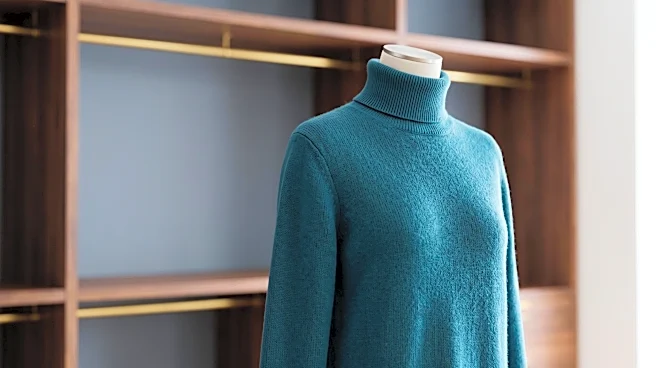
But these first impressions say almost nothing about how the dress will perform over time. A cheap acrylic blend can feel wonderfully soft initially, and a poor construction job isn’t obvious in a mirror selfie. The real test of a sweater dress comes after a day of sitting at a desk, a cycle in the wash, or a season of wear. Common complaints about bagging, stretching, and pilling are rarely captured in those glowing, day-one reviews. This is because the most crucial quality indicators aren't about the superficial look or feel, but about how the garment was fundamentally made.
The Real Secret: Construction and Knit Density
The detail that separates a dress that lasts for years from one that droops in weeks is its construction. Most sweater dresses are made in one of two ways: 'cut and sew' or 'fully fashioned.' Cut-and-sew is the dominant method for mass-market clothing. A large sheet of knitted fabric is cut into pattern pieces and then sewn together, just like a t-shirt. It’s fast, cheap, and often results in bulky, awkward seams that can twist and pull. 'Fully fashioned,' on the other hand, is a hallmark of higher quality. Each individual panel of the dress—the front, back, and sleeves—is knitted to its precise shape and size. These pieces are then linked together with a seamless finish. This method requires more skill and time, but it results in a garment that drapes beautifully, fits better, and maintains its structure. Paired with a dense, tight knit, this construction method is the ultimate sign of quality. A dense knit means more yarn is used, creating a stable fabric that resists sagging and holds its shape.
From Chic Silhouette to Shapeless Sack
So why does this technical difference matter? Because it directly impacts how the dress looks and feels on your body after minimal wear. A loosely knit, cut-and-sew dress has no structural integrity. The knit itself is unstable, and the seams are weak points. Gravity becomes its enemy. The weight of the yarn pulls the dress downward, causing it to grow longer throughout the day. Areas under stress, like the elbows and seat, will permanently bag out, creating that dreaded saggy look. In contrast, a fully fashioned dress with a dense knit behaves as a single, cohesive unit. The shaped panels and linked seams distribute weight and stress evenly. The fabric has memory and resilience, allowing it to snap back into shape. It moves with your body instead of fighting against it, ensuring the silhouette you bought is the one you get to keep, wear after wear, wash after wash.
Your 30-Second Quality Test in the Store
You don't need to be a textile expert to spot quality. Next time you're shopping for a sweater dress, ignore the price tag for a moment and perform this quick physical. First, inspect the seams, especially around the shoulders and sides. Do they look like two pieces of fabric sewn together, with a bulky, raised edge? That’s cut-and-sew. If the seam looks flat, integrated, and almost invisible, you're likely looking at a fully fashioned piece. Second, hold a single layer of the fabric up to the light. If you can easily see through the stitches, it's a loose, low-density knit that will likely lose its shape. A quality knit will be opaque and feel substantial. Finally, test its recovery. Gently stretch a small section of the fabric for a few seconds. Does it immediately spring back to its original form, or does it leave a stretched-out dimple? A quick snap-back is a sign of high-quality yarn and a dense, well-constructed knit.