









Spielberg, Our Ambassador to the Stars
For decades, Hollywood conditioned us to fear the cosmos. Aliens were invaders, monsters, or colonizers hell-bent onstrip-mining our planet and harvesting our organs. From the tripods of War of the Worlds to the acid-blooded xenomorphs of Alien, the message
was clear: if they come, run. Then came Steven Spielberg. While he wasn’t the first to imagine peaceful aliens, he became the chief architect of our collective hope. More than any other filmmaker, Spielberg framed extraterrestrial contact not as a threat, but as an opportunity for wonder. His aliens weren’t here to conquer us; they were here to communicate, to learn, or, in the case of a certain Reese’s Pieces-loving botanist, to simply phone home. This optimistic, humanist lens is what makes his work the default cultural touchstone for the UFO phenomenon, creating the cinematic language we use to imagine a world post-disclosure.
The Masterpiece: Communication at Devils Tower
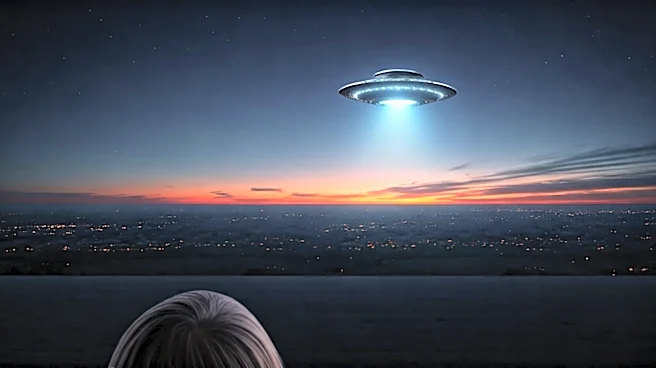
If you have to pick one sequence, it’s not the suburban magic of E.T. or the terrifying spectacle of his 2005 War of the Worlds. The scene everyone will pull up on YouTube is the breathtaking, 20-minute finale of 1977’s Close Encounters of the Third Kind. Set against the stark silhouette of Wyoming's Devils Tower, it’s a symphony of light and sound. The colossal mothership descends, dwarfing the secret government base. But instead of unleashing weapons, it initiates a conversation. What follows is one of cinema’s most beautiful dialogues, a call-and-response between the ship’s booming five-note musical phrase and the scientists’ earthbound synthesizer. It’s a math-and-music lesson on a cosmic scale. Spielberg films this not like a battle, but like a religious experience. The awe on the faces of the scientists, led by François Truffaut’s gentle character, Lacombe, says it all. This isn't an invasion; it's a breakthrough.
Why This Scene Is the One
The power of the Close Encounters finale lies in its process. It acknowledges that first contact wouldn’t be a simple “take me to your leader” moment. It would be difficult, abstract, and require our best minds. The scene validates the scientific pursuit, celebrating the patient work of finding a common language where none exists. The breakthrough comes when Lacombe uses hand signals corresponding to the musical tones—a system developed by Zoltán Kodály for teaching music to children. The message is profound: our universal languages are not words, but math, music, and a childlike willingness to connect. Furthermore, the scene is devoid of malice. The aliens that finally emerge are graceful, curious, and peaceful. They return the human abductees from decades past, unharmed and not having aged. They invite Roy Neary (Richard Dreyfuss) aboard not as a prisoner, but as an ambassador. It’s the ultimate best-case scenario, a vision of contact rooted in mutual respect and boundless curiosity.
An Antidote to Modern Cynicism
Let’s be honest: a real Disclosure Day would likely be messy. It would be filtered through cable news panic, geopolitical posturing, and social media misinformation. The dominant emotions would almost certainly be fear and suspicion, not wonder. We are a far more cynical and divided world than the one in which Close Encounters was released. And that’s precisely why we’ll need this scene. Spielberg’s vision won’t be a roadmap for what to expect, but a balm for our anxieties. It will serve as an aspirational blueprint—a reminder that humanity is capable of meeting the unknown not with fists clenched, but with arms outstretched and a song on our lips. The scene argues that our capacity for awe is a more powerful tool than our capacity for destruction. It’s a deeply optimistic statement about who we could be, even if it’s not who we are right now.