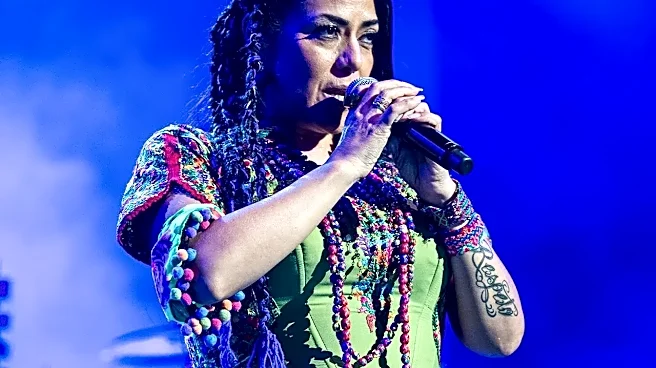

When the Latin Recording Academy honors Lila Downs with a Lifetime Achievement Award this year, it’s celebrating more than a singer. It's an overdue recognition of a cultural force who has spent three
decades as an activist, anthropologist, and artist.
A Voice That Crosses Borders
To understand Lila Downs is to first hear her voice, a stunning instrument that moves effortlessly between the growl of a blues singer, the precision of an opera vocalist, and the raw emotion of a ranchera legend. Born in Oaxaca to a Mixtec mother and an American father, Downs embodies a living bridge between cultures. Her music is a vibrant tapestry, weaving together Mexican folk traditions with American jazz, blues, and even hip-hop. This refusal to be boxed into one genre is her signature. She can deliver a heart-wrenching bolero one moment and a politically charged rock anthem the next, all unified by her powerful vocal delivery and a profound connection to her roots. This sonic fusion brought her international attention, particularly with her 2001 album 'Border' and her contributions to the soundtrack for the 2002 film 'Frida'.
The Musical Anthropologist
Before she was a global music icon, Downs studied anthropology, a discipline that has deeply informed her artistic mission. She is not just a performer of traditional music; she is a preservationist. Downs has dedicated much of her career to rescuing and revitalizing the indigenous languages of Mexico, recording songs in Mixtec, Zapotec, Mayan, and Nahuatl, among others. In a world where these languages and the cultures they represent are under threat, her work is a radical act of cultural conservation. By placing these ancient sounds in a modern context, she introduces them to new generations and global audiences, ensuring they are not relegated to museums but remain a living, breathing part of the cultural landscape. This work has made her a vital ambassador for Mexico's rich, multicultural identity.
An Activist Who Sings Her Truth
For Lila Downs, music has always been a tool for social change. She has never shied away from tackling difficult subjects, using her powerful platform to sing about the issues that define our times. Her lyrics often explore the painful realities of migration, social injustice, and the historical struggles of indigenous communities and women. This commitment was powerfully demonstrated in her album 'Border', which confronted the dangers faced by those crossing into the United States. The inspiration for it came from a searing personal experience: while working in Oaxaca, she had to translate a death certificate for a man whose son had drowned while trying to cross the border. That moment galvanized her resolve to use her art as a form of testimony, giving voice to the voiceless and challenging listeners to confront uncomfortable truths.
A Legacy of Authenticity and Power
The Lifetime Achievement Award recognizes the entirety of an artist’s contribution, and for Lila Downs, that contribution is immense. Over a career spanning more than 30 years and featuring multiple Grammy and Latin Grammy wins, she has redefined what it means to be a Latin artist on the world stage. She has collaborated with a diverse range of musicians, from Carlos Santana and Norah Jones to the late Chavela Vargas, who reportedly named Downs her successor. Through her bold fashion, which prominently features traditional Oaxacan textiles, and her fearless stage presence, she presents a vision of Mexico that is complex, proud, and unapologetically modern. She has performed at Carnegie Hall and the White House, always bringing the vibrant spirit of her Oaxacan roots with her.