




Pelé, 1958: A King is Crowned
Before the 1958 final in Sweden, Edson Arantes do Nascimento was a 17-year-old prodigy, a brilliant but largely unknown quantity outside of Brazil. He was a kid with immense promise, but the world had yet to truly see him. After 90 minutes against the host
nation, he was simply Pelé, the first global soccer superstar. In a dazzling performance that defied his age, Pelé scored two goals—the first a breathtaking flick over a defender followed by a volley, the second a looping header. Brazil won 5-2, securing its first World Cup. But the real story was the teenager who cried on his teammate's shoulder at the final whistle. He had gone from a talented boy to a national hero and a worldwide icon in a single evening. His legacy was no longer about potential; it was the birth of a king.
Zinedine Zidane, 1998: The Unlikely Scorer
Zinedine Zidane was already a world-class midfielder heading into the 1998 final on home soil in Paris. He was known as a sublime playmaker, a master of touch and vision for Juventus, but not as a prolific goalscorer. His legacy was that of an elegant creator. The final against a heavily favored Brazil, led by his contemporary Ronaldo, changed that forever. With the weight of a nation on his shoulders, Zidane did the unthinkable: he scored two powerful headers from corners, giving France a commanding 2-0 halftime lead. They were the goals of a dominant forward, not a graceful number 10. France went on to win 3-0, and Zidane was instantly elevated from a great player to a French national deity. He won the Ballon d'Or that year, and his legacy was rewritten as not just a genius, but a clutch, decisive champion who delivered on the biggest stage imaginable.
Ronaldo, 2002: A Redemption for the Ages
No player has ever entered a World Cup final with more baggage than Ronaldo Nazário in 2002. Four years earlier, he was the face of the 1998 final before suffering a mysterious convulsive fit hours before kickoff. A shadow of himself, he was anonymous in Brazil's loss to France. His legacy became intertwined with that tragic failure and subsequent career-threatening knee injuries. By 2002, he was a comeback story, but the ultimate question remained: could he conquer his demons? Against Germany, he answered with a resounding yes. After a cagey first half, Ronaldo pounced on a rebound from German keeper Oliver Kahn for the first goal, then clinically finished a second to seal a 2-0 victory. It was the ultimate story of redemption. The performance erased the ghosts of 1998 and recast his legacy from one of tragic fragility to one of resilience and undeniable greatness. He wasn't the player who failed; he was the hero who came back and conquered.
Andrés Iniesta, 2010: Spain's Silent Hero
In the constellation of stars that was Spain's 2010 team, Andrés Iniesta was essential but understated. He was the brilliant midfield partner to Xavi, the facilitator for striker David Villa, but rarely the man in the headlines. His legacy was that of a quiet genius, a critical component of a historic machine for both Barcelona and Spain. The final in Johannesburg against a rugged Netherlands side was a brutal, scoreless affair heading into the dying minutes of extra time. Then, in the 116th minute, the ball fell to Iniesta in the box. He didn't hesitate, firing a clean volley into the far corner. The goal gave Spain its first-ever World Cup. In that single, explosive moment, Iniesta transformed from a beloved technician into an immortal national hero. He was no longer just part of the system; he was the man who delivered Spain its most glorious sporting moment.
Lionel Messi, 2022: The Final Coronation
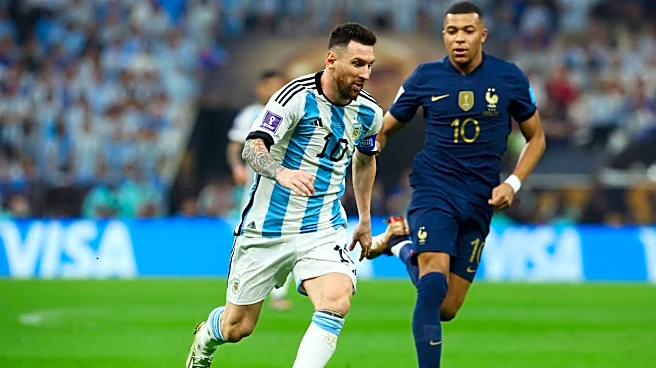
For nearly two decades, the debate was settled for many: Lionel Messi was a club legend, but Diego Maradona was Argentina's god because he had delivered a World Cup. Messi had won everything else, but his legacy felt incomplete, haunted by a loss in the 2014 final. The 2022 final in Qatar was his last chance. What followed was perhaps the greatest final ever played. Messi scored a penalty, then scored again in extra time. He was the calm center of a chaotic masterpiece against a Kylian Mbappé-inspired France. When Argentina finally won on penalties—with Messi coolly converting his—the narrative changed instantly. He had not just won the World Cup; he had done so as the undeniable leader and protagonist. The final argument against his status as the greatest of all time vanished. His performance completed the last chapter of his story, cementing a legacy that now stands alone at the pinnacle of the sport.