







The Scene: A Powder Keg in Mexico City
The 1986 World Cup quarter-final between Argentina and England was never going to be just a game. Held at Estadio Azteca in Mexico City, the match was weighted with intense political subtext. Just four years prior, the two nations had fought the Falklands
War, a brief but bitter conflict that left deep wounds, particularly in Argentina. For many Argentinians, the soccer pitch was a symbolic battlefield, an opportunity for a different kind of victory against England. The tension was palpable among the 114,580 fans, creating a charged atmosphere where sport and national pride were inextricably linked.
The 'Hand of God'
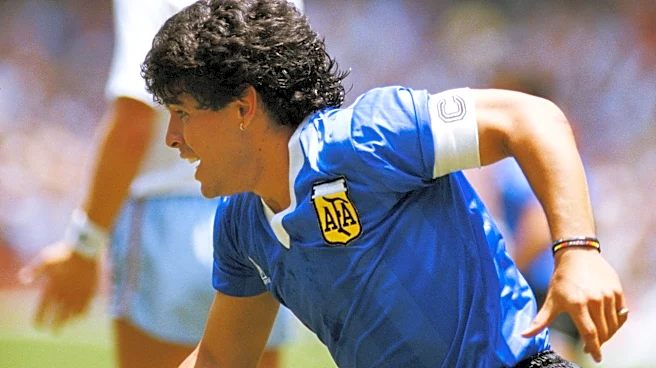
Six minutes into the second half, with the game locked at 0-0, the moment arrived. Argentine captain Diego Maradona chased a looping, miscued clearance from England's Steve Hodge into the penalty area. The ball dropped from the sky as the 5-foot-5-inch Maradona challenged England's towering goalkeeper, Peter Shilton. As Shilton stretched his arms to claim the ball, Maradona leaped and, with a subtle flick of his left fist, punched it into the net. The English players protested furiously, but the Tunisian referee, Ali Bin Nasser, saw no infringement and allowed the goal to stand. In a post-match interview, Maradona cheekily credited the goal "a little with the head of Maradona and a little with the hand of God." The name stuck, immortalizing the act.
The 'Goal of the Century'
The controversy of the 'Hand of God' could have defined any other match. But this was no ordinary match, and Maradona was no ordinary player. Just four minutes after his infamous first goal, he produced a moment of undisputed magic. Receiving the ball inside his own half, Maradona embarked on a breathtaking 60-yard dash that took him a mere 11 seconds. He slalomed past five English players—Peter Beardsley, Peter Reid, Terry Butcher, Terry Fenwick, and then Butcher again—before rounding goalkeeper Peter Shilton and slotting the ball into the empty net. This goal was later voted FIFA's "Goal of the Century," a moment of sublime genius that stood in stark contrast to his earlier act of cunning deception. The two goals, scored minutes apart, encapsulated the duality of Maradona: the cheat and the genius, forever linked.
A Legacy of Cheating or Cleverness?
Argentina won the match 2-1 and went on to win the World Cup. In England, the 'Hand of God' is remembered as a blatant act of cheating that cost the nation a fair chance. For many Argentinians, however, it was a display of 'viveza criolla'—native cunning and street smarts—and a symbolic form of revenge for the Falklands. Maradona himself later admitted he knew the goal was illegitimate and considered it payback. The incident cemented his status as a folk hero in his home country and a villain in England, fueling a debate that continues to this day. Was it an unforgivable breach of sportsmanship or a clever exploitation of the game's human element? The answer often depends on which side of the divide you stand.
The Ghost in the Machine
Today, the 'Hand of God' goal simply wouldn't happen. The introduction of the Video Assistant Referee (VAR) system means such an obvious handball would be spotted and overturned in seconds. Maradona himself, a supporter of VAR before his death, admitted that technology would have disallowed the goal. This raises a fascinating question for the modern game: while VAR ensures greater fairness and eliminates clear errors, does it also remove the possibility of these iconic, folklore-generating moments? The 'Hand of God' was born from human fallibility—both Maradona's decision to cheat and the referee's failure to see it. It created a legend, a debate, and a piece of soccer history that, for better or worse, remains unforgettable precisely because of its imperfection.