




The Rebranding: From UFO to UAP
First, let’s talk language. The official shift from “Unidentified Flying Object” (UFO) to “Unidentified Anomalous Phenomena” (UAP) is more than just government jargon. It was a strategic move to destigmatize the topic. UFO carries decades of pop culture
baggage, conjuring images of tin-foil hats and tabloid covers. UAP, on the other hand, sounds clinical, serious, and broad. It encompasses not just objects in the sky but also phenomena observed underwater or even transiting between domains. This simple change in terminology allowed military personnel and politicians to discuss the issue without professional ridicule. It created a permission structure for serious people to have a serious conversation, framing it not as a hunt for little green men, but as a matter of national security and airspace integrity.
The Messengers Became Unimpeachable
The nature of the witnesses has fundamentally changed. Gone are the days of relying on shaky accounts from anonymous sources. Today’s key figures are people with sterling credentials and everything to lose. Take David Fravor, the former Commanding Officer of a U.S. Navy fighter squadron who engaged the now-famous “Tic Tac” UAP in 2004. Or Ryan Graves, another former F/A-18 pilot who described near-daily encounters with unexplained objects off the Atlantic coast. These aren’t conspiracy theorists; they are highly trained observers entrusted with multi-million dollar military assets. Then came David Grusch, a former intelligence official who, in a 2023 congressional hearing, testified under oath about an alleged multi-decade UAP crash retrieval and reverse-engineering program. While his claims are extraordinary and unverified, his background as a veteran of the National Geospatial-Intelligence Agency and the National Reconnaissance Office lends them a gravity that is impossible to dismiss outright.
Congress Is Finally Taking It Seriously
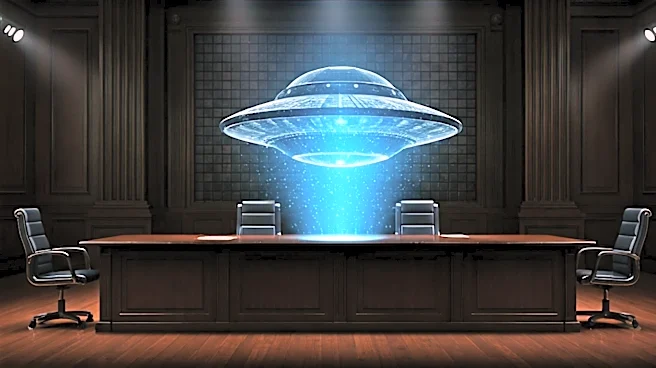
Perhaps the most significant factor is the sudden, bipartisan interest from Congress. For the first time, lawmakers from both sides of the aisle are demanding answers, not as a pet project but as a legitimate oversight duty. Senators like Marco Rubio (R-FL) and Kirsten Gillibrand (D-NY) have spearheaded legislation requiring the Pentagon and intelligence agencies to take UAP reports seriously and centralize the data. The 2023 House Oversight Committee hearing wasn’t a political sideshow; it was a formal inquiry into government transparency and potential national security risks. When politicians like Tim Burchett (R-TN) and Jared Moskowitz (D-FL) are united in demanding declassification and grilling Pentagon officials, it signals a profound shift. The political risk is no longer in discussing UFOs, but in being seen as part of a cover-up.
The Pentagon's Reluctant Transparency
After decades of official denial and dismissal, the Department of Defense is slowly, and perhaps reluctantly, opening the door. It started with the stunning official release of three Navy videos—codenamed “FLIR,” “GIMBAL,” and “GOFAST”—confirming their authenticity. This was followed by the creation of the UAP Task Force and, more recently, the establishment of the All-domain Anomaly Resolution Office (AARO). This office is tasked with synchronizing efforts across the government to detect, identify, and attribute UAPs. While the Pentagon’s public statements remain cautious, often emphasizing there’s no proof of extraterrestrial origins, the very existence of this bureaucratic infrastructure is a monumental change. The government has built an official machine to investigate the phenomenon, implicitly acknowledging there is something real and persistent worth investigating.