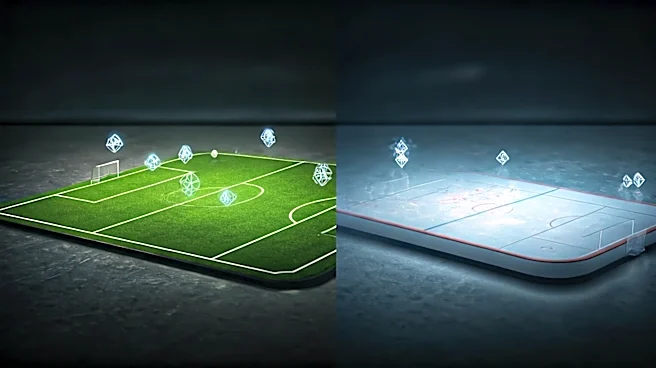








The Balanced Workhorse: 4-4-2 as a 1-2-2 Forecheck
The 4-4-2 is the meat-and-potatoes of soccer formations: four defenders, four midfielders, and two strikers. It’s balanced, easy for players to understand, and covers the entire field evenly. Its strength is its structure. The two banks of four create
a defensive block that’s hard to break down, forcing opponents to the outside. Think of this as the classic 1-2-2 forechecking system in hockey. One forward pressures the puck carrier (the F1), while two others and the two defensemen form layers behind them, taking away passing lanes through the neutral zone. The goal isn’t necessarily to create a turnover deep in the opponent's end; it’s about establishing control, maintaining defensive shape, and preventing easy entry into your zone. The 4-4-2 functions the same way. It dares the other team to find a way through its disciplined, layered setup, patiently waiting for a mistake before transitioning to an attack.
All-Out Attack: The 4-3-3 as an Aggressive 2-1-2
When you see a team in a 4-3-3—four defenders, three midfielders, and a dynamic front three—you know they came to score goals. This is a high-risk, high-reward system designed for offensive pressure and fluid movement. The three forwards (often a central striker flanked by two wingers) are tasked with relentlessly hounding defenders, a tactic known as a “high press.” The goal is to win the ball back as close to the opponent’s goal as possible.
This is the soccer equivalent of a coach screaming “Get in on the forecheck!” and sending in an aggressive 2-1-2. Two forwards (F1 and F2) attack the puck carrier hard below the goal line, trying to force a panic-pass or turnover. The third forward (F3) acts as a high safety valve, ready to pounce on any loose pucks coughed up into the slot. Both the 4-3-3 and the 2-1-2 are about dictating the terms of engagement, forcing the action in the offensive zone, and creating scoring chances through sheer pressure. The trade-off? You can be left vulnerable to a quick counter-attack if the opponent breaks through that initial wave of pressure.
Parking the Bus: The 5-4-1 as the Neutral Zone Trap
Ever watch an underdog hockey team desperately clinging to a one-goal lead in the third period? They often collapse into a neutral zone trap, like the infamous 1-3-1. The goal is simple: clog up the middle of the ice, give the opponent nothing, and make them dump the puck in. It’s frustrating, defensive, and brutally effective.
Welcome to soccer’s 5-4-1 formation, often called “parking the bus.” With five defenders, four midfielders, and a lone striker, this system is unapologetically defensive. The team essentially builds a wall in front of its own goal, surrendering possession and territory in exchange for defensive solidity. The five defenders make it nearly impossible to find space in the penalty area, while the four midfielders clog up passing lanes just in front of them. The lone striker is an outlet, hoping to get on the end of a long clearance and steal a goal on the counter-attack. It may not be pretty, but like a good trap, it’s designed to suffocate skill and grind out a result.
The Specialist System: 4-2-3-1 as a Power Play
The 4-2-3-1 has become one of the most popular formations in modern soccer. It’s a variation of the 4-4-2, but with a crucial difference: one of the central midfielders is pushed into an advanced attacking midfield role (the “number 10”), right behind the striker. This creates a system built around a primary playmaker.
This is best understood by thinking about a hockey power play. While every player has a role, the system is often designed to funnel the puck to one or two key specialists—the “quarterback” on the half-wall or the triggerman in the high slot. The 4-2-3-1 operates similarly. The two deep-lying midfielders provide a stable defensive base, much like the two defensemen at the blue line. The wide players and striker stretch the defense and create space. But the star of the show is the number 10, who operates in that newly created space, much like a power-play specialist finding a soft spot in the penalty kill. The entire structure is geared toward getting your most creative player on the ball in a dangerous position.