

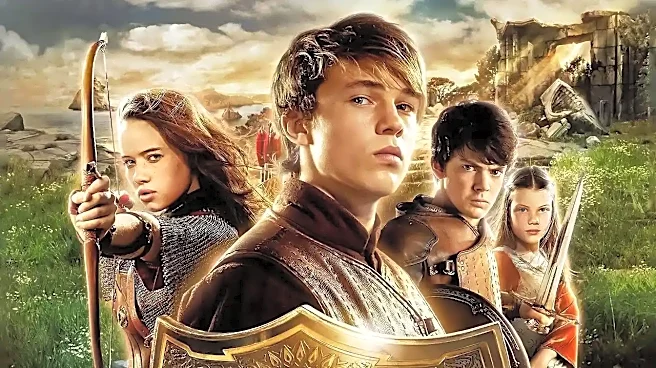
With Greta Gerwig set to adapt 'The Chronicles of Narnia' for Netflix, fans are wondering how her modern, character-focused style will merge with C.S. Lewis's epic fantasy. Her point of view is everything. Here’s what to look for.
The Director's Signature Style
Before diving into Narnia,
it’s crucial to understand what makes a Greta Gerwig film. Her work, from 'Lady Bird' to 'Little Women' and 'Barbie', is defined by a deep interest in the inner lives of her characters, especially young women on the cusp of self-discovery. She favors a 'honeycomb' structure, building stories around key emotional moments rather than a rigid plot. Her dialogue is famous for its realistic, overlapping quality, where characters interrupt and talk over each other, creating a rhythm that feels utterly true to life. This isn't improvisation; it's meticulously scripted to feel spontaneous. She focuses on the messy, complex, and often joyful journey of 'becoming'. This intimate, humane, and slightly chaotic energy is what she’ll bring to a world of talking lions and magical wardrobes.
Lucy's First Trip Through the Wardrobe
The first entry into Narnia is one of fantasy literature's most iconic moments. Where other adaptations might focus on the epic scale of a new world, expect Gerwig to anchor the point of view tightly to Lucy. We won't just see the snowy woods; we'll experience them through her specific sensory details. Think of the tight, character-focused framing Gerwig often employs. The camera might stay close on Lucy's face, capturing her mix of fear, wonder, and the quiet indignation of a child who has discovered something magical that no one else will believe. The encounter with Mr. Tumnus could play out with the awkward, charming rhythm of a 'Frances Ha' scene, focusing on the connection and tentative trust between two lonely beings, rather than just the plot mechanics of the White Witch's scheme.
Edmund and the Turkish Delight
Edmund's betrayal is often painted in broad strokes of good versus evil. Gerwig's approach will likely be more psychological. She excels at exploring flawed characters with empathy. Instead of a purely wicked act, his seduction by the White Witch could be framed through the lens of his insecurities as a younger brother overshadowed by Peter. The point of view would emphasize his desire to be seen as important and special. Gerwig's films often contrast a romanticized idea of an experience with its messy reality. The Turkish Delight scene is perfect for this: the magical candy is tempting, but the true focus will be on Edmund's gnawing loneliness and the subtle, manipulative conversation that exploits his all-too-human desire for power and recognition.
The Sacrifice at the Stone Table
Aslan's death and resurrection is the allegorical heart of the book. While the Christian symbolism is unavoidable, Gerwig's point of view will likely be grounded in the raw, human-level grief of Lucy and Susan. Much like she found the 'epicness in kitchens' in 'Little Women', she will find the story's power not just in the cosmic stakes, but in the devastating experience of two young girls watching their hero be humiliated and killed. The focus will be on their perspective—hiding, watching, and weeping. Gerwig has a reverence for C.S. Lewis's work and his faith, but her storytelling instinct is to translate abstract spiritual ideas into tangible, emotional experiences. The scene's power will come from seeing this monumental event through the terrified, loving eyes of the children.
The Battle for Narnia
Fantasy battles often prioritize spectacle. A Gerwig-directed battle, however, would likely feel more personal and chaotic. Drawing on her use of overlapping dialogue and rapid-fire pacing, the soundscape might be a flurry of shouts, commands, and cries, reflecting the disorienting reality of combat. The point of view could jump between the Pevensie siblings, focusing on their individual experiences rather than a detached, wide shot of the armies. We might see Peter's fear as he leads the charge for the first time, Susan's focused precision with her bow, and Lucy's desperate race with her healing cordial. It wouldn't just be a fight for Narnia; it would be a story about children forced to grow up in an instant, with the emotional weight of that transformation at the forefront.