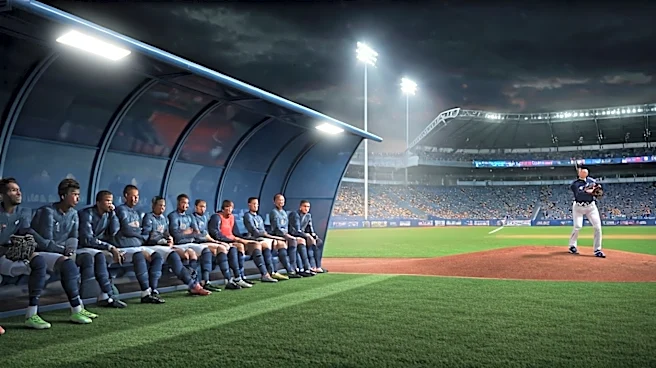

Baseball’s Blueprint: The Bullpen
Let’s start with the familiar. In baseball, the starting pitcher is the star of the show, but everyone knows they can’t go the distance alone. That’s where the bullpen comes in. It isn't just a random
collection of backup pitchers; it's a highly specialized unit designed to solve specific problems over the final innings. You have the long reliever to eat up innings after a starter’s early exit, the lefty specialist to get a single crucial out against a dangerous hitter, the setup man to bridge the gap in the 8th, and the closer—the high-leverage, ice-in-his-veins specialist brought in to slam the door. A deep, versatile bullpen gives a manager a Swiss Army knife of options to protect a lead, stop a rally, and navigate the tactical chess match of the late innings. A weak bullpen, on the other hand, is a liability that can undo seven innings of brilliant work in a matter of minutes.
Soccer’s Evolution: The Five-Sub Revolution
For decades, soccer managers had a much more limited toolkit. With only three substitutions allowed, they were primarily used for injuries or a desperate, late-game roll of the dice. But a recent, pandemic-era rule change, now permanent in most major leagues, has completely transformed the game: teams can now make five substitutions. This has elevated the bench from a mere safety net to a vital strategic component, much like the bullpen. A manager no longer has to hope their starting eleven can survive 90-plus minutes of high-intensity running. They can now plan for waves of attack, systematically replace tired players, and introduce tactical specialists to change the flow of the game. The bench isn’t just for backups anymore; it's the second wave.
Managing the Grind
The most direct parallel is managing fatigue. A starting pitcher hits 100 pitches, and their velocity and control start to fade. A central midfielder in soccer covers nearly seven miles in a match, and by the 70th minute, their legs are heavy, their decision-making slows, and they’re a step late to a crucial tackle. Bringing in a fresh arm from the bullpen is the exact same principle as subbing on a fresh pair of legs from the bench. In both sports, the replacement player has a massive physical advantage over an opponent who has been battling for over an hour. This isn’t just about avoiding a decline in performance; it’s about injecting a burst of energy that can fundamentally shift the momentum of the contest.
The Tactical Chess Match
Here’s where the analogy gets really sharp. A baseball manager brings in a hard-throwing righty to face a power hitter who struggles with high heat. It’s a move designed to exploit a specific weakness and create a favorable matchup. A modern soccer manager does the exact same thing. Is the opponent’s left-back looking tired and carrying a yellow card? Sub on your fastest, most aggressive right-winger and tell them to attack that flank relentlessly. Is the other team dominating the midfield? Bring on a strong, defensive-minded midfielder to clog passing lanes and disrupt their rhythm. Like a bullpen full of pitchers with different strengths—sinkerballers, flamethrowers, control artists—a deep soccer bench should have players who offer different tactical solutions: speed, height, defensive solidity, or creative passing.
Shutting the Door
The 9th inning. Your team is up by one. The call is made, and the closer trots in from the bullpen to a roar from the crowd. His only job: get three outs. This is perhaps the most potent comparison. In soccer, the equivalent is the “game management” substitution around the 85th minute. When protecting a 1-0 lead, a manager will often take off an attacking player and bring on a rugged defender or a possession-savvy midfielder. Their job isn’t to score goals; it’s to kill the game. They tackle, they shield the ball in the corner, they slow the pace, and they help see out the victory. Just like a baseball closer, these players are specialists in high-pressure situations, trusted to protect a fragile lead when everything is on the line.