






The Original Power Trio
For anyone who discovered Demetri Martin in the mid-2000s, the formula was iconic and inseparable from the man himself. His breakthrough special, Demetri Martin. Person. (2007), established a beloved comedic trio: Martin’s deadpan, Steven Wright-esque
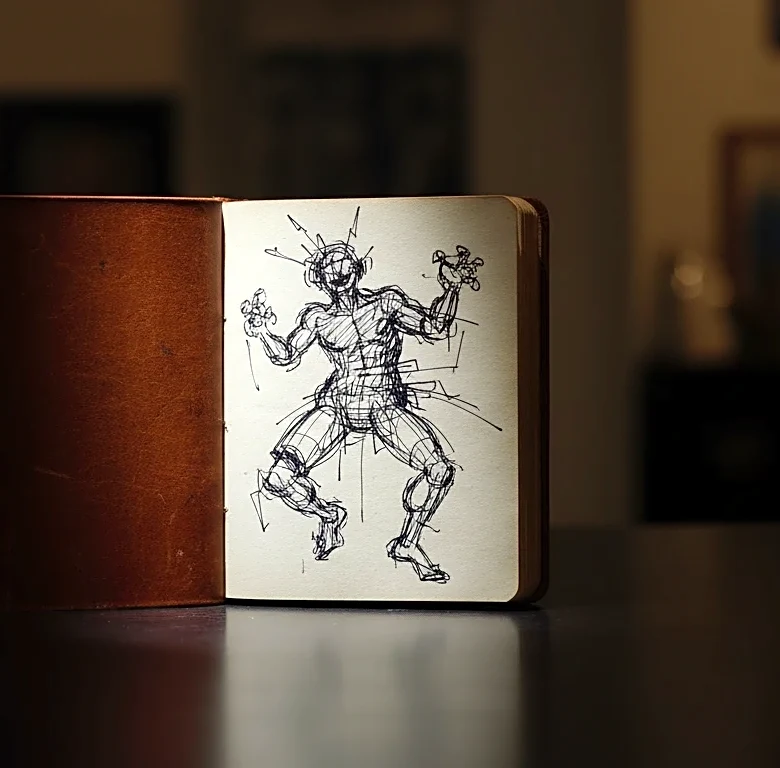
delivery; his acoustic guitar for musical non-sequiturs; and, most famously, his “large pad.” This oversized sketchpad wasn’t just a prop; it was a full-fledged cast member. It served as the visual core for some of his most memorable bits, using crude-but-clever graphs, charts, and drawings to deconstruct everything from state shapes to the physics of farting. This multimedia approach set him apart. While other comics told stories, Martin presented data, turning his stand-up into a quirky, academic, and hilarious presentation. The pad was his silent partner, the straight man to his abstract observations.
A Shocking Disappearance
Then, something started to change. Fans who tuned into his 2015 Netflix special, Live (At the Time), noticed a stark difference. The stage was emptier. While the guitar remained, the large pad was conspicuously absent. It was a deliberate creative choice that fundamentally altered his performance. The move signaled a departure from the visual-gag-heavy style that had made him a star. Reviews from the time noted that without the sketchpad, the special was more stripped-down, forcing Martin to rely solely on his words and delivery. This wasn't a sudden firing but a gradual phasing out. The artist was intentionally breaking up the band to see if the frontman could survive on his own.
Surviving on Pure Wit
So, how did his act survive losing its most unique member? By doubling down on the one thing the props were always there to support: the intricate workings of Martin's mind. His later specials, including The Overthinker (2018), saw a shift inward. The comedy became less about illustrating external absurdities and more about exploring internal anxieties and linguistic rabbit holes. He was still the master of the one-liner, but the subject matter grew. Instead of a chart about Hummer owners, he would deconstruct the logic of the term “donut hole” or explore the existential dread of common phrases. In an era of comedy dominated by deeply personal, long-form storytelling, Martin remained a defiant joke-teller. But by shedding his visual aids, he proved his jokes could land just as hard, powered by pure intellect and wordplay rather than a sight gag.
The Overthinker's New Toolkit
In place of the large pad, Martin began experimenting with the format of the special itself. The Overthinker features on-screen text, voice-overs, and meta-commentary on the joke-telling process, letting the audience inside his head in a new way. It’s as if the analytical energy once funneled into his drawings was now being used to deconstruct the very act of stand-up comedy. While the large pad made a brief, almost nostalgic appearance in the special, it was no longer the star. The new “cast” was Martin’s own self-awareness. He was still challenging himself, just in a different arena. This evolution showed an artist unafraid to dismantle a winning formula. He let go of his most reliable partner to prove that the real magic wasn't on the paper, but in the mind that held the pen.