





The Material Is Everything
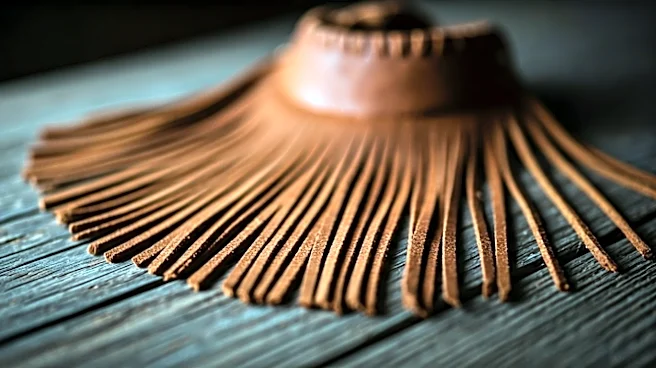
The soul of authentic Western fringe lies in its material. Traditionally, artisans use high-quality leathers like deerskin or soft-tanned cowhide suede. These natural materials possess a crucial combination of qualities: they are dense, pliable, and have
significant weight. Deerskin, in particular, is prized for its supple texture and beautiful drape. When cut into thin strands, each piece retains enough individual mass to move with purpose. It has a life of its own, responding to the slightest motion with a smooth, flowing cascade. Fast fashion, on the other hand, relies on petroleum-based synthetics. Polyurethane (PU or “pleather”) and polyester suede are the common culprits. These materials are engineered to be lightweight and cheap to produce. While they can mimic the look of leather from a distance, they lack its fundamental density and suppleness. The result is a fringe that feels plasticky, stiff, and too light to generate any real momentum.
It’s All in the Cut and Construction
How fringe is created is just as important as what it's made from. In traditional leatherworking, fringe is often cut directly from the garment’s pattern piece or as long, individual strands that are then painstakingly attached. This ensures each strand is a discrete element, free to swing, twist, and dance independently. This separation is key to creating the iconic, mesmerizing ripple effect. Fast-fashion manufacturing prizes speed and efficiency over artistry. Fringe on a cheap jacket is often die-cut or laser-cut from a single sheet of synthetic material. Sometimes, the strands are not fully separated at the base or are partially melted together during the cutting process. This forces them to move as a single, clumpy unit rather than as a collection of individuals. Instead of a fluid sway, you get a stiff, paddle-like flap that lacks any grace or subtlety.
The Simple Physics of the Swing
At its core, the difference comes down to simple physics, specifically momentum. Momentum equals mass times velocity. The heavier strands of real leather or suede have significantly more mass than their flimsy synthetic counterparts. When you move, you impart energy to the fringe, giving it velocity. Because the leather strands have greater mass, they build up more momentum. This allows them to continue their arc, swinging back and forth in a graceful, pendulous motion long after the initial movement has stopped. Lightweight polyester fringe, with its negligible mass, can't hold that energy. It stops almost as soon as it starts, resulting in a jerky, static, or non-existent swing. It’s the difference between pushing a child on a swing (who has mass and will arc back and forth) and pushing an empty plastic bag (which will just flutter and stop).
The Character of Age
Finally, there’s the element of time. A real leather or suede jacket gets better with age. The material softens, conforms to the owner’s body, and the fringe becomes even more fluid and responsive as the fibers break in. It develops a character and a story. A fast-fashion synthetic piece does the opposite. Instead of breaking in, it breaks down. The PU coating can crack and peel, the polyester strands can fray or pill, and the material generally becomes more brittle and less attractive over time. It’s a disposable item designed for a trend cycle, not a lifetime. That satisfying, heavy swing of authentic fringe isn’t just a detail; it's a testament to the quality of the materials and the integrity of the craftsmanship—a physical expression of durability that disposability can never truly imitate.