



The Controlled Canvas of an Arena
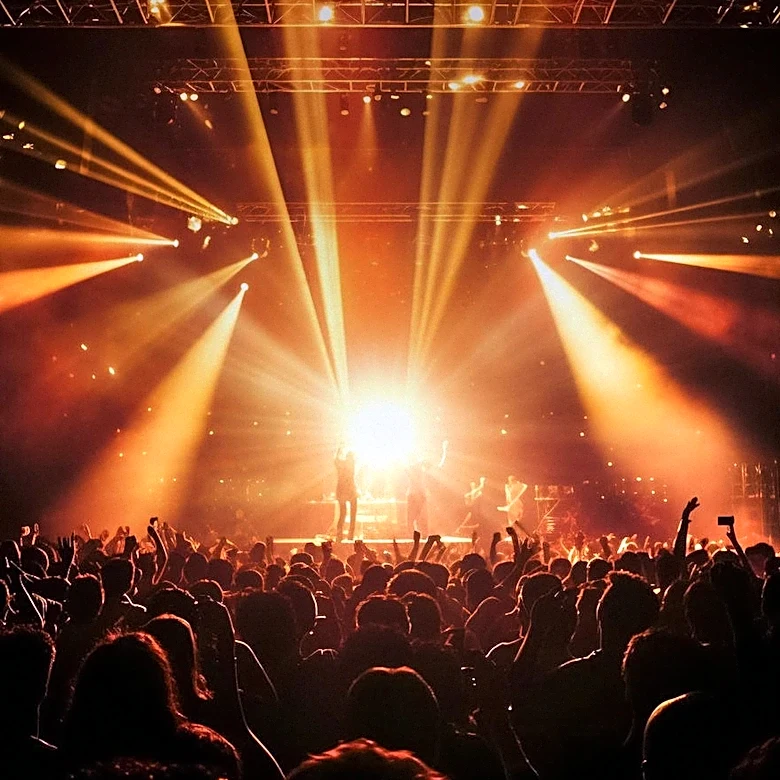
Think of the last major arena show you saw. The artist wasn't just on a stage; they were inside a living, breathing visual world. Towering LED screens displayed crisp, cinematic content, lasers cut through manufactured haze, and every light fixture was precisely
angled, all contributing to a story told in photons. An arena is a black box—a perfectly controlled environment. Production designers have total command over darkness, temperature, and sightlines, allowing them to use every tool in the visual arsenal, from delicate projections to floor-to-ceiling video walls, to craft an immersive experience. This highly engineered setup is the product of months of planning and programming, designed to be replicated flawlessly in nearly identical venues night after night.
The Great Outdoors: Daylight and Other Enemies
Now, take that perfectly calibrated show and drop it into Golden Gate Park for Outside Lands. The biggest and most immediate challenge is the sun. For any set scheduled before dusk, intricate video projections are rendered completely useless. Even the most powerful and expensive LED screens, which look brilliant in an arena, can appear washed out and muted in bright daylight. This forces a fundamental shift in strategy. The focus moves from detailed, cinematic video to bold, high-contrast graphics that can punch through the ambient light. Color palettes are simplified, and movement is exaggerated. It's less about creating a movie and more about creating a powerful, moving graphic that reads from hundreds of feet away. The second enemy is the environment itself. Wind can make large video screens act like sails and play havoc with atmospheric effects like fog and haze, blowing them away before they can catch the light. Every element must be bigger, brighter, and tougher.
Adapting to the Fog City Microclimate
Outside Lands presents its own unique set of meteorological hurdles, famously including San Francisco's fog, affectionately nicknamed Karl. While a touring production might use haze machines to create atmosphere, Golden Gate Park often provides its own for free. This can be a blessing and a curse. A light mist can beautifully capture laser beams and spotlights, creating a stunning natural backdrop. But a thick, soupy fog can obscure sightlines, turn visuals into a blurry mess, and make the air damp, which affects how long certain effects linger. Then there’s the wind whipping off the Pacific Ocean, which can be a safety hazard for large temporary structures and equipment. Production teams must consult detailed weather forecasts not just for rain, but for wind speed, humidity, and temperature shifts, which can affect everything from how fog behaves to how equipment performs.
It's Not Subtraction, It's Reinvention
The smartest production designers don't just subtract elements from their arena show to make it fit a festival stage; they reinvent it. The process starts with a new creative brief: how do we create the same emotional impact with a different set of tools? Often, this means shifting the reliance from screen content to lighting. Instead of a detailed video narrative, the show might lean on powerful washes of color, strobes synchronized to the beat, and sweeping spotlights that engage the entire crowd. Physical set pieces, which might be secondary in an arena show, can become the main visual focus. For many festivals, a single lighting rig has to serve every band on the bill for the day, offering a set number of lights in fixed positions. A touring artist's lighting designer will arrive with a pre-programmed show on a hard drive, ready to adapt their cues to the festival's specific rig, a process that requires both technical skill and creative flexibility.
The Art of the On-the-Fly Adjustment
Ultimately, the success of a festival set comes down to the people running the show from the production tent in the middle of the field. The lighting director and video director (VJ) often have multiple versions of the show programmed: a daylight version, a sunset version, and a full nighttime version. The transition during the "magic hour" of sunset is often the most dynamic, as the fading light allows them to gradually introduce more complex visuals. A great festival production team is constantly reading the environment. Is the fog thicker than expected? They might switch to lighting effects that punch through it. Is the crowd's energy flagging? A burst from a CO2 jet or a powerful strobe sequence can re-engage them. It's a live performance not just for the musician on stage, but for the technicians at the mixing boards, who are translating an artistic vision into a shared, unforgettable moment.