

The Song That Silenced the Harbor
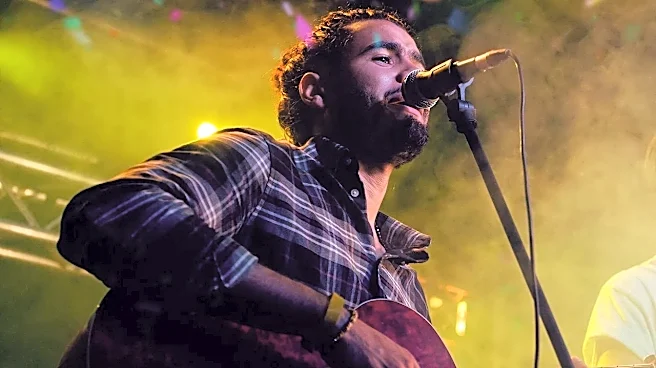
It’s a scene that feels almost radical in today's festival landscape. John R. Miller, recipient of the John Prine Songwriter's Fellowship, stood on stage with just his acoustic guitar, accompanied by a fiddle and a slide guitar. Instead of competing with the sounds
of a sprawling festival, his set commanded a different kind of power: the power of stillness. As he played, a hush fell over the audience. In that shared quiet, his sorrowful voice and intricate lyricism—reminiscent of Prine himself—created a moment of profound, focused connection. This wasn't a set you danced to; it was one you stopped everything for, a performance that drew its strength not from volume, but from the rapt attention of a crowd that came to listen.
The Newport Effect: A Culture of Listening
What makes such a moment possible? It’s the Newport effect. For decades, the festival has cultivated an environment that prioritizes artistry over spectacle. Held at the historic Fort Adams State Park, its multiple stages are traversed by fans who are famously engaged and respectful. It’s common to see conversations spark up between strangers, not about the party, but about which sets moved them the most. This is a place where legends like Joni Mitchell and Paul Simon have made surprise appearances, but the festival’s true magic lies in its consistent ability to elevate pure, unadorned songwriting. Unlike festivals driven by spectacle, Newport has built its legacy on the idea that a great song is the only special effect you truly need.
Redefining the 'Headliner'
While the 2026 festival had its share of traditional headliners, including The Lumineers and a surprise six-song solo set from Dave Matthews, Newport consistently redefines what a “headliner moment” means. It might be the intricate harmonies of Gillian Welch and David Rawlings delivering an acoustic set of Grateful Dead songs. Or it could be the duo Haley Heynderickx & Max García Conover, whose voices blended so perfectly they drew comparisons to Bob Dylan and Joan Baez on that same historic ground. At Newport, a headliner isn't just the artist with the biggest name on the poster. It’s any artist who can forge a powerful, communal experience, often with the simplest of tools. John R. Miller’s set was a testament to this, proving that in the right environment, a quiet song can feel as monumental as any arena anthem.
An Antidote to the Modern Festival
The modern music festival is often a sensory overload—a relentless barrage of bass drops, light shows, and overlapping sound bleed. Newport stands as a cherished alternative. The festival has always championed the idea that folk music is a broad, inclusive church, but its central pillar remains the song itself. The success of quiet, stripped-down performances is no accident; it’s by design. It’s fostered by an audience that trusts the curation and comes ready to discover new artists on smaller stages, not just rush to the main event. In a world of distraction, the shared, focused silence during an acoustic song at Newport feels like both a luxury and a necessity—a reminder of music's fundamental power to connect us.