

The Core Idea: Help Defense on Grass
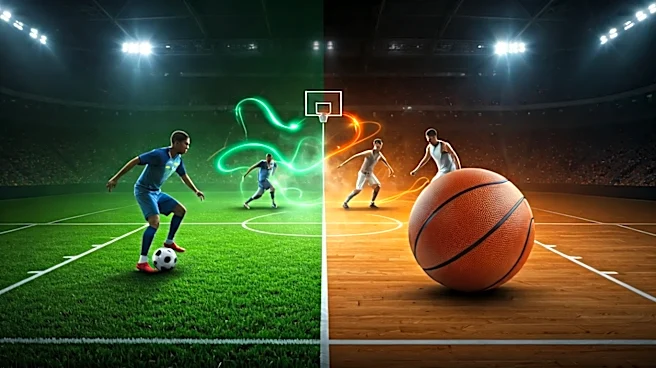
Let’s start with the basics. In basketball, if your man drives past you on the baseline, what happens? Your teammate in the paint—the 'help' defender—slides over to stop the easy layup. But that leaves his player open. So a third defender must 'rotate'
over to cover that newly open man. This is a defensive rotation. Soccer works on the exact same principle, just on a much larger scale. When a right-back (think a perimeter defender) charges up the field to join the attack, he leaves a huge space behind him. A central midfielder or a center-back (your power forward or center) must slide over to cover that gap. This prevents the opponent from launching a quick counter-attack into the vacated area. It’s not random running; it's a chain reaction of covering for a teammate who has taken a risk. It’s help defense, pure and simple.
It’s About Spacing and Denying Lanes
Good NBA defenses don't just guard their own man; they maintain proper spacing to clog passing lanes and protect the paint. Players exist in a 'shell,' connected by invisible strings. If one player moves, the others adjust to keep the defensive shape intact. Soccer is identical. A team’s defensive formation—whether a 4-4-2 or a 4-3-3—is their version of a defensive shell. As the ball moves from one side of the field to the other, the entire team shifts as a single unit. They’re not chasing the ball so much as they are protecting valuable real estate. The goal is to stay compact, deny easy passes through the middle (the equivalent of 'the paint'), and force the offense into predictable, low-percentage attacks on the wings. A breakdown in rotation isn’t just one player getting beat; it’s the whole shell collapsing, opening a passing lane for a killer through-ball that leads to a goal.
The Soccer Pick-and-Roll: The Overlap
How do you break down a great defense? In basketball, you use a pick-and-roll to create a 2-on-1 advantage and force the defense into a tough decision. Soccer’s version of this is the 'overlap' or 'underlap.' Imagine a winger (your shooting guard) has the ball on the sideline, marked by a defender. Suddenly, his fullback (let’s call him the point guard) sprints forward on the outside, 'overlapping' him. The defender is now in a bind. Does he stay with the man on the ball or follow the runner? It's a 2-on-1. This action forces the defending team to rotate instantly. Another defender must leave their assignment to pick up the overlapping runner. This is the soccer equivalent of a defense having to 'switch' or 'hedge' a screen. If the rotation is a split-second too late, the overlapping player gets a cross into the box—the equivalent of an open lane to the hoop.
Offensive Flow: Positionless Soccer
Modern basketball isn't just about five players sticking to their designated spots. Think of the Golden State Warriors' motion offense, where players are constantly cutting, screening, and filling space. Steph Curry might start as the point guard but end up finishing a play like a shooting guard, while Draymond Green, a forward, initiates the offense. This is 'player interchange,' and it’s a dominant force in modern soccer. A central striker might drift to the wing, pulling a defender with him and creating space for a midfielder to run into. A winger might 'invert' and cut into the middle of the field, acting like a central playmaker. This fluid rotation of positions is designed to do one thing: confuse the defense. It breaks down rigid man-to-man marking and creates mismatches, just as a small-ball lineup does in the NBA. The players aren't abandoning their roles; they are swapping them dynamically to exploit an opportunity.