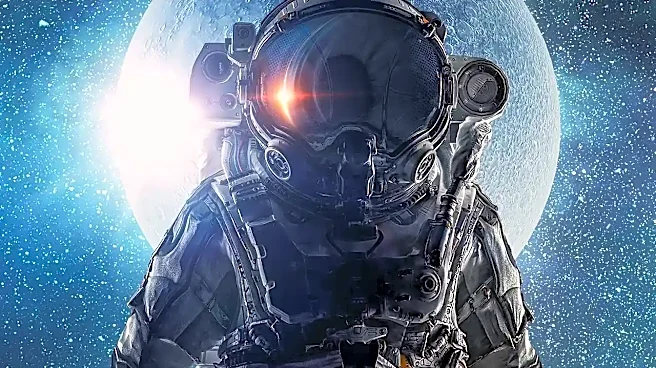









The Ultimate Amnesia Opening
Starting a story with an amnesiac hero is a well-worn trope, but Weir turns it into a powerful narrative tool. When protagonist Ryland Grace wakes up on a spaceship, he doesn't just have amnesia about the mission—he doesn't even remember his own name.
The reader and the protagonist are placed on the exact same footing, sharing a profound and immediate sense of disorientation. You learn who he is at the same time he does. This isn't just a gimmick; it’s an invitation. By stripping away Grace's identity, Weir forces the reader to join him in the most fundamental quest: figuring out who he is and what in the world is happening. Every small discovery, from his own scientific knowledge to the lifeless bodies of his crewmates, is a shared revelation that builds a powerful sense of intimacy and urgency. The mystery isn't just about the mission; it's about the man.
Science as the Plot Engine
In a Weir novel, science isn't just background detail; it's the engine of the story. Before Grace can even begin to contemplate the mission, he has to solve the problems right in front of him using the scientific method. He deduces he's in zero gravity, that a centrifuge provides artificial gravity, and that he’s on a spaceship. Each logical step, explained with Weir’s signature blend of humor and clarity, serves as a mini-puzzle that both the character and the reader get to solve together. This approach, sometimes called "competence porn," is deeply satisfying. It transforms potentially dry exposition into active, forward-moving plot. The story doesn't stop for an info-dump. Instead, the process of scientific discovery is the story. We are hooked not by what the mission is, but by the compelling process of how a brilliant mind solves one impossible problem after another.
A Voice You Immediately Trust
The novel is told entirely from Ryland Grace's first-person perspective, and his voice is the secret ingredient that makes it all work. He’s brilliant but self-deprecating, terrified but endlessly resourceful, and armed with the relatable charm of a favorite middle school science teacher. This isn’t the stoic, fearless astronaut of classic sci-fi. Grace is prone to anxiety and panic, yet he always pushes through it with logic and a quip. This flawed humanity makes him instantly trustworthy and likable. You're alone in space with him, and his is the only voice you have to guide you. That witty, intelligent, and deeply human narration is a lifeline for the reader, creating a bond so strong that you’re willing to follow him anywhere, even when neither of you has any idea where you're going.
Micro-Puzzles Over Grand Reveals
Instead of front-loading the story with the world-ending stakes of the mission, Weir masterfully breaks the narrative down into a series of small, solvable mysteries. Why do I know this particular scientific fact? What is this strange alien substance? Who were these crewmates I'm waking up next to? Each question is a breadcrumb that leads to the next, providing a steady drip of satisfaction and intrigue. The flashbacks, which slowly fill in Grace's memory, are triggered by events in the present, ensuring they feel earned and relevant rather than like clunky exposition. This structure keeps the reader constantly engaged and rewarded. You don’t need to know that the fate of the world is at stake to be completely invested. You just need to know the answer to the next, immediate question, and Weir makes you desperate to find out.