








Casting a Nobody for a War Epic
Consider the film that cemented her legacy: "The Hurt Locker." By the 2000s, war films that lacked major movie stars were considered a tough sell. Yet for the lead role of Staff Sergeant William James, a nervy bomb-disposal expert, Bigelow chose the relatively
unknown Jeremy Renner. Studios, naturally, would have preferred a household name to anchor a risky Iraq War drama. Bigelow, however, had seen something unique in Renner’s earlier work, particularly his role as the serial killer Jeffrey Dahmer. She recognized his ability to make a difficult, even unlikable, character sympathetic and compelling. Her intention was to cast actors without the "baggage" of audience preconceptions. By casting an unfamiliar face, Bigelow ensured that the audience would not be able to predict who would live or die based on their level of fame, amplifying the film's gut-wrenching tension. The choice was a masterstroke, earning Renner an Oscar nomination and proving that for Bigelow, the right face is always more important than the famous one.
The Unproven Anchor for a Global Manhunt
Bigelow doubled down on this philosophy with "Zero Dark Thirty," her tense thriller about the decade-long hunt for Osama bin Laden. The film’s narrative rests squarely on the shoulders of Maya, the fiercely intelligent CIA analyst at the center of the search. To play her, Bigelow cast Jessica Chastain. While Chastain was a rising talent, she was not yet the established star who could single-handedly open a major, politically charged film. Bigelow's instinct was to find an actor who could embody the role's obsessive focus without the distraction of celebrity. In an interview, the director explained her preference for less famous actors in roles meant to be true to life, stating she wants it to be an "original experience for the audience." She didn't want viewers thinking about an actor's past performances. Chastain’s powerful, nuanced portrayal of Maya’s relentless pursuit became the film's soul, earning her an Academy Award nomination and once again validating Bigelow's counterintuitive approach.
An Ensemble of Faces, Not Names
For her 2017 film "Detroit," which dramatizes the harrowing Algiers Motel incident during the 1967 Detroit riots, Bigelow took this principle to an even greater extreme. Rather than building the film around one or two stars, she assembled a large ensemble cast of emerging or little-known actors, including John Boyega, Will Poulter, and Algee Smith. This decision was crucial for a story that demanded an almost documentary level of realism. In a story about systemic violence and ordinary people caught in a nightmare, the presence of major movie stars could easily have shattered the illusion. By populating the film with fresh faces, Bigelow immersed the audience in the sweltering, terrifying atmosphere of the period. Each performance felt raw and immediate, contributing to a collective portrait of a city on fire. A studio executive, looking at the call sheet, might have seen a lack of marketable names; Bigelow saw an opportunity to build a world that felt painfully, undeniably real.
The Philosophy Behind the 'Confusion'
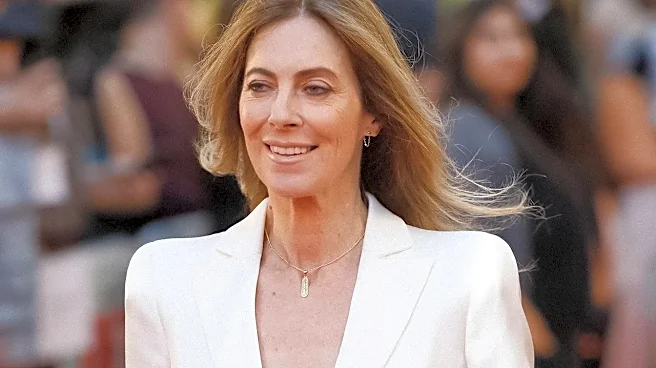
The confusion among studio executives stems from a fundamental clash of priorities. For a studio, casting is primarily a financial calculation designed to mitigate risk. For Bigelow, it is an essential part of her world-building. Her background is not in theater or comedy clubs, but in the visual arts. She approaches her films with a painter's eye and a conceptual artist's rigor, seeking what she calls an "ultra-realist style." She needs actors who are soldiers as much as they are performers, people who can blend into the hyper-realistic, often brutal, environments she creates. Bigelow is drawn to actors who don't feel like "glamorous Hollywood movie stars who were showing up to do a war movie." This commitment to authenticity, from shooting on location in the Middle East to casting for emotional truth over box-office track records, is the throughline of her career. The executives weren't confused because her choices were bad; they were confused because she was playing a different game entirely.