




From Hesitant Heir to Hardened Queen
Remember the Rhaenyra of season one? The reluctant heir burdened by a prophecy she never asked for, more comfortable with her children on Dragonstone than with the vipers in King's Landing. Emma D'Arcy masterfully established that foundation of a woman
who sought peace, not as a political tactic, but as a genuine desire to protect her family. D'Arcy’s portrayal was never that of a simple, entitled princess. Instead, they imbued Rhaenyra with a palpable sense of duty weighed against a deep-seated fear of her destiny, a fear rooted in the fate of her own mother. This earlier softness is not a weakness in the character but the crucial first act of her tragedy. D'Arcy showed us a Rhaenyra who believed, perhaps naively, that her rightful claim would be enough. That restraint, that hope for a better way, makes her current descent all the more devastating to watch.
A Masterclass in Grief
The death of a child can shatter a person, and D'Arcy has had to portray that devastation twice. After the loss of Lucerys at the end of season one, the finale hinged on a single, silent turn to the camera, a face contorted with a rage so profound it needed no words. More recently, the death of her firstborn, Jace, has been met with widespread praise for D'Arcy's raw and gut-wrenching performance. In what fans and critics have called an impeccable and haunting portrayal, D'Arcy presented the stages of grief with a physicality that felt terrifyingly real. They show us a character who once thought she was an expert in loss, having lost parents and lovers, only to receive a "re-education in grief." It is this accumulated, unbearable pain that now fuels the war. It's not about politics anymore; it’s a mother’s vengeance, and D'Arcy ensures the audience feels every ounce of that fire.
The Power of a Look
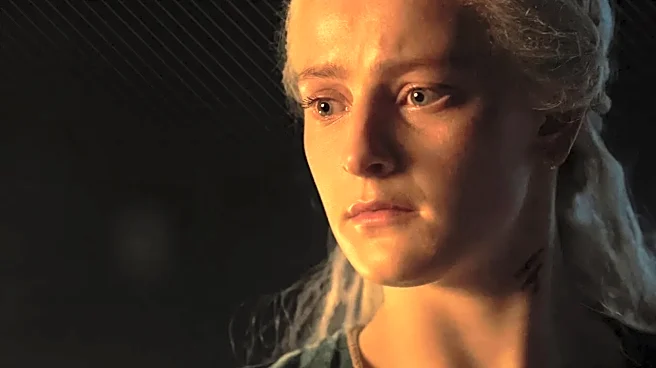
For all the dragons and epic battles, some of D'Arcy's most powerful work happens in near silence. So much of their performance is communicated through facial expressions and reactions alone, a testament to their skill. Whether it's the quiet paranoia flickering in her eyes as she sits the Iron Throne or the way she carries the physical memory of trauma, D'Arcy excels in the moments between the lines. While others in Westeros shout their intentions, Rhaenyra's resolve often hardens in a clenched jaw or a steely gaze. This subtlety is vital. It pulls the audience in, forcing us to watch her think and feel, to understand that her actions are born from a roiling internal world of pain and pressure. It’s a quiet performance that makes the eventual screams of war and dragon fire feel earned and deeply personal.
Setting the Stage for a Tragic Payoff
Heading into the finale, Rhaenyra is no longer just the rightful heir; she is a woman hollowed out by loss and forged into something new and terrifying. D'Arcy has guided us through every step of this transformation: the dutiful daughter, the loving mother, the betrayed queen, and now, the avenging fury. Some critics have noted that the show's writing sometimes struggles to give Rhaenyra full agency, but D'Arcy’s performance consistently elevates the material, grounding the queen’s sometimes wavering resolve in a bedrock of believable emotion. They carry the weight of a character who must choose between the peace she always wanted and the war that has been forced upon her. The tragedy isn’t just that a war is coming, but that we’ve watched a woman we understand be pushed to her absolute limit. D'Arcy has made the political personal, ensuring the finale will be felt not as a fantasy spectacle, but as the heartbreaking conclusion to one woman's story.