


When director Jon M. Chu announced the 'Wicked' adaptation would be two films, the immediate question was: Why? While the story is long, the real reason is far more creative, allowing for a visual journey that simply couldn't happen in one movie.
More Than Just a Long Story
The simplest
answer for splitting 'Wicked' is its length. The beloved Broadway musical clocks in at nearly three hours, and cramming its dense plot, character arcs, and iconic songs into a single film felt like a recipe for disaster. Director Jon M. Chu stated that trying to condense the story would have caused 'real damage' and felt like 'fatal compromises'. But the decision went beyond just avoiding cuts. It was about giving the narrative room to breathe. Chu explained that with more space, the filmmakers could delve deeper into the characters' motivations and the complexities of their relationships, particularly the bond between Elphaba and Glinda. A single film would have required narrative leaps that work on stage but feel jarring on screen. By making two movies, the story could unfold with the emotional depth and logical progression it deserved, ensuring each part felt like a complete, satisfying film on its own.
A Tale of Two Palettes
The two-part structure is a gift to the film's visual storytellers, allowing for a deliberate and dramatic shift in tone and color. Part one can fully embrace the bright, seemingly idyllic world of Oz. Production designer Nathan Crowley built expansive, tangible sets—from the nine million real tulips of Munchkinland to the grand, surrealist architecture of Shiz University—to create a world that feels happy and immersive. This allows the audience to experience Oz as Elphaba and Glinda first do: a place of wonder and promise. In contrast, 'Wicked: For Good' can visually descend into the story’s darker, more political themes. As Elphaba is branded a villain and the Wizard's regime shows its true colors, the aesthetic can shift. The vibrant world of the first film gives way to a more mature, and at times more somber, visual language that reflects the characters' disillusionment and the story's rising stakes.
Character Through Costume
Costume designer Paul Tazewell used the two-film canvas to map the characters' internal journeys onto their external appearances. For Glinda, her evolution is from a popular schoolgirl into a public figurehead for the Wizard's propaganda. Her clothing becomes more elegant and beautiful, a visual representation of the 'goodness' she is forced to project, even as she grapples with inner turmoil. Elphaba's transformation is even more pronounced. In 'Wicked: For Good', her look becomes a 'mutation' of her former self. Her Shiz uniform is gone, replaced by clothing that is distressed, weathered, and assembled from the remnants of her past, reflecting a woman who has been hardened by exile but remains in control of her identity. Her iconic hat, a joke in the first film, evolves to become larger and more defined—a solidifier of her power and persona. This slow burn of visual development would be impossible in a single, rushed narrative.
The Evolving Emerald City
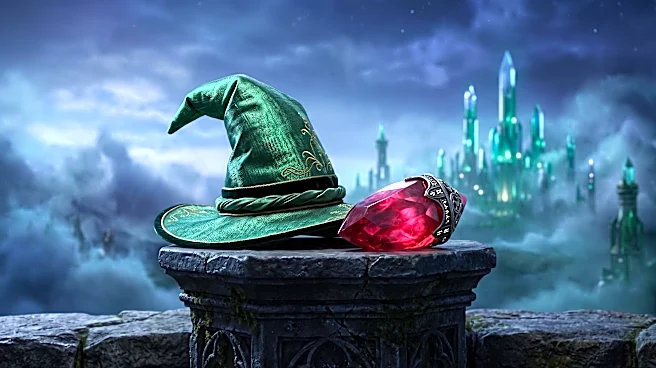
Nowhere is the visual shift more apparent than in the Emerald City. In the first film, it's the ultimate destination, a dazzling metropolis of Beaux Arts-inspired architecture that embodies Elphaba's dream of meeting the Wizard. The design is intentionally spectacular and intoxicating. However, the split allows 'Wicked: For Good' to reframe it. What was once a symbol of hope becomes the seat of a corrupt, oppressive power. The green, once magical, can take on a more sinister, authoritarian quality. The giant, mechanized head of the Wizard, modeled on Jeff Goldblum, perfectly illustrates this; it's a piece of performative grandeur that hides a hollow truth. This environmental storytelling, where a familiar location's meaning and appearance shift with the narrative, is a direct benefit of the two-part structure, allowing the world itself to have a character arc.