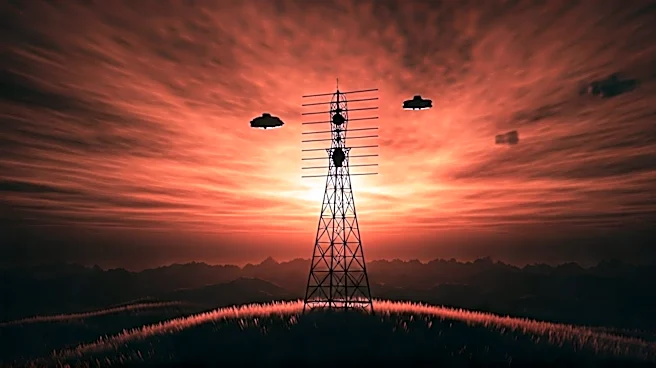







What Exactly Is 'Disclosure Day'?
First, let's be clear: “Disclosure Day” isn’t a new federal holiday you missed. It’s a term of art, born in the fervent communities of UFO enthusiasts and researchers, used to describe any moment of significant government revelation about Unidentified
Anomalous Phenomena (UAPs), the new, more sterile term for UFOs. For decades, it was a hypothetical date on the horizon. But lately, these “Disclosure Days” have started to feel less like fiction and more like a series of actual events, thanks to a surprising new player in the game: the U.S. government itself. What used to be relegated to grainy photos and late-night radio shows is now the subject of official Pentagon reports and sober Congressional hearings. Each new declassified video or testimony acts as a mini-disclosure, sending ripples of speculation across the internet and, yes, into your phone.
The Whistleblower Who Broke the Internet
The latest wave of excitement—or anxiety, depending on your perspective—was supercharged by David Grusch, a former high-level intelligence official. In 2023, Grusch came forward with explosive claims under oath before Congress. He alleged that the U.S. is in possession of “non-human” spacecraft and has been running a secret, multi-decade program to reverse-engineer the technology. He even testified that “non-human biologics” were recovered from alleged crash sites. This wasn’t some anonymous blogger; this was a decorated combat veteran and insider who worked on the Pentagon’s UAP task force. His testimony provided the perfect cocktail of credibility and jaw-dropping assertions, moving the goalposts from “did we see a weird light?” to “did we recover bodies?” While his claims remain unproven and are based on information he says he was told by others, they provided more than enough fuel to restart the conversation with a new, more serious intensity.
From Fringe Topic to Capitol Hill
The most significant shift isn't just one person’s testimony, but the institutional framework growing around it. The conversation has officially moved from Area 51 fan forums to the halls of Congress. Bipartisan groups of lawmakers are now demanding transparency, citing UAPs as a potential national security threat, regardless of their origin. Whether they are advanced drones from a foreign adversary or something more… exotic, the logic goes, the government needs to take them seriously. This has led to the creation of the Pentagon’s All-domain Anomaly Resolution Office (AARO), tasked with cataloging and analyzing UAP reports from military personnel. While AARO’s public-facing reports have been far more cautious than whistleblower testimonies—concluding there is no evidence of extraterrestrial technology—the very fact that such an office exists and is reporting to Congress represents a monumental change from the decades of official denial and ridicule.
So… Is It Aliens?
This is the billion-dollar question, the one that’s lighting up the group chat. And the official answer is a resounding, unsatisfying, “We don’t know.” Officials are clear on what they *aren’t* saying. No government body has confirmed the existence of extraterrestrial life. Instead, their public position is focused on the known unknowns. Pilots are reporting objects that perform maneuvers beyond any known human technology. These objects are being tracked on radar and other sensors. They represent a safety risk to military aviators and a potential intelligence gap. By framing it as a national security issue, the government has found a socially acceptable way to investigate the phenomenon without immediately jumping to extraterrestrial conclusions. But that deliberate ambiguity is precisely what leaves the door wide open for the biggest question of all.