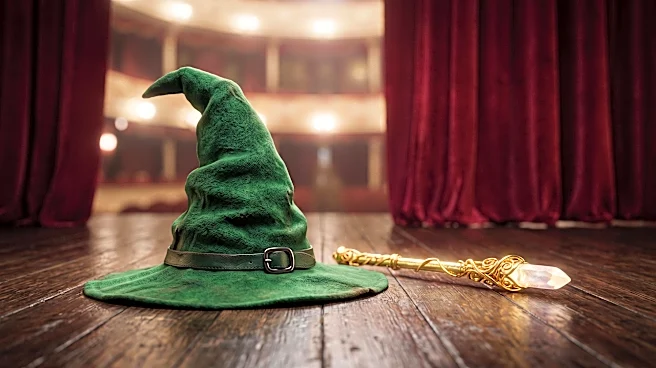








Before it was a global Broadway sensation defined by gravity-defying vocals, 'Wicked' was a dense, dark, and deeply political novel. The journey from Gregory Maguire’s complex book to the stage is a story of inspired reimagination.
A Darker, Sharper Oz
Gregory Maguire published
'Wicked: The Life and Times of the Wicked Witch of the West' in 1995. His Oz was not a whimsical fairytale land; it was a gritty, politically charged landscape rife with corruption, propaganda, and social strife. Inspired by the rhetoric surrounding the Gulf War and a desire to explore the nature of evil, Maguire sought to understand how a person becomes 'wicked'. His protagonist, Elphaba, is not a simple villain but a complex, intelligent, and misunderstood animal rights activist born with emerald-green skin. The novel is a sprawling, often grim narrative that tackles themes of terrorism, racism, and political assassination, presenting a far more cynical and adult version of the world L. Frank Baum created. Many key characters from the musical meet tragic ends in the book, and the story delves into dark subject matter, including murder and morally ambiguous affairs.
An Accidental Discovery
The idea to turn this dense novel into a musical came from an unlikely place: a vacation. Composer and lyricist Stephen Schwartz was on holiday in Hawaii when a friend mentioned Maguire's book. The concept immediately sparked his interest. Schwartz had always been drawn to stories that re-examine a familiar narrative from a different perspective, much like Tom Stoppard's 'Rosencrantz and Guildenstern Are Dead'. He saw the potential for a powerful stage adaptation and began the long process of securing the rights, which were held by Universal Pictures for a potential non-musical film. After about a year of persistence, Schwartz successfully persuaded producer Marc Platt that 'Wicked' was better suited for the stage. Platt, who had been in a college production of Schwartz's musical 'Pippin', was receptive to the idea.
From Political Allegory to Unlikely Friendship
To adapt the story, Schwartz turned to writer Winnie Holzman, the creator of the acclaimed TV series 'My So-Called Life', admiring her ability to write convincing young female characters. Together, they spent a year outlining the musical before writing a single word. The most crucial decision they made was to shift the story's focus. Instead of retaining the novel's sprawling political plot, Holzman suggested centering the narrative on the complex relationship between the two witches, Elphaba and Glinda. This pivot transformed the story from a political allegory into an intimate tale of an unlikely friendship between two women who start as rivals but ultimately change each other's lives. Many of the book’s darker elements and supporting characters were cut, and the tone was made significantly lighter to appeal to a broad theatrical audience. The Wizard became a more charming manipulator rather than a sinister tyrant, and Fiyero's arc was reshaped into a more heroic and clear-cut romance.
A Legacy 'For Good'
The result of this adaptation was a cultural phenomenon. The musical 'Wicked' premiered on Broadway in 2003 and became one of the highestst grossing shows in history. Its success lies in its universal themes of friendship, accepting differences, and being true to oneself. The focus on the emotional journey of Elphaba and Glinda, crystallized in iconic songs like 'Defying Gravity' and 'For Good', resonated with audiences in a way the darker, more philosophical novel may not have. While some fans of the book found the musical too lighthearted, the adaptation succeeded by creating a more accessible and ultimately uplifting story. Gregory Maguire himself has praised Holzman's work, stating that she turned his novel into an opera and that the core themes he cared about were maintained. The two versions of 'Wicked' now coexist, each offering a distinct experience: one a complex, thought provoking novel for those who enjoy darker fantasy, and the other a dazzling, emotionally resonant musical that has captured the hearts of millions.