





1. The Elastico
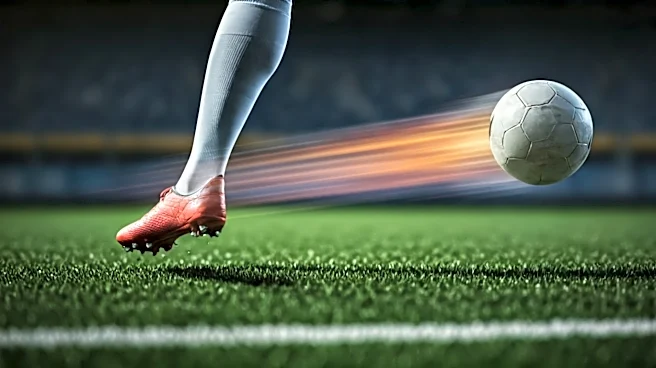
Imagine a ball seemingly attached to a player’s foot by an invisible rubber band. That’s the Elastico. The attacker uses the outside of their boot to push the ball in one direction, feinting a move, then in a split second, uses the inside of the same
foot to snap it back the other way. The defender, who has already committed their body weight to follow the initial fake, is left completely stranded. Their hips are locked, their feet are planted, and their dignity is somewhere on the other side of the field. Popularized by Brazilian legend Rivelino in the 1970s and perfected into a global phenomenon by Ronaldinho in the 2000s, the Elastico is pure magic. It’s a move that defies expectation. For the defender, the brain sees the ball going right, the body follows, and by the time the signal comes that it was a lie, the attacker is already gone. It’s less a dribble and more a magic trick, and the defender is the unfortunate volunteer from the audience.
2. The Cruyff Turn
Some moves are flashy. The Cruyff Turn is just brutally, elegantly efficient. Invented and immortalized by Dutch master Johan Cruyff at the 1974 World Cup, this move is a masterclass in deception through simplicity. The setup is key: the attacker shapes their body as if to launch a powerful cross or shot. The defender braces for impact, turning to block the expected ball. But the ball never comes. Instead, Cruyff would drag the ball behind his own standing leg with the inside of his foot, spinning 180 degrees into the now-empty space. The defender, facing the wrong way and preparing for an entirely different scenario, is rendered obsolete. It’s a move that weaponizes a defender’s own instincts against them. The fake is so convincing that by the time the defender realizes they've been duped, Cruyff was already accelerating into acres of space they had just vacated. It’s the definition of playing chess while everyone else is playing checkers.
3. The Nutmeg (or Panna)
There are moves that get you past a player, and then there’s the nutmeg. This isn’t just about advancing the ball; it’s a psychological kill shot. The goal is simple and profoundly disrespectful: to play the ball directly through the defender’s open legs. Executing it in a professional match is the ultimate power play. It says, “Not only am I better than you, but I’m going to use the space between your own feet to prove it.” When a player like Lionel Messi or Luis Suárez—both masters of the craft—pulls it off, the stadium erupts. For the defender, it’s the worst possible outcome. They haven’t just been beaten; they’ve been embarrassed on a fundamental level. They are momentarily turned into a training cone, a human goalpost. The physical act of turning to find the ball is secondary to the mental recovery needed after being so thoroughly dominated in a one-on-one duel.
4. The Stepover
The stepover is a hypnotic dance. An attacker rhythmically loops their legs over and around the ball without touching it, feinting left, then right, then left again. It’s designed to do one thing: short-circuit a defender’s brain. With each feint, the defender has to make a decision, but with multiple, rapid-fire stepovers, they are overloaded with false information. Do they lunge left? Right? Stay put? The hesitation is fatal. While many players use a single stepover as a simple feint, players like the Brazilian Ronaldo Nazario and Portugal's Cristiano Ronaldo turned it into an art form. They used a dizzying series of stepovers to mesmerize defenders, freezing them in place before exploding in the opposite direction. It’s a move that preys on indecision. The defender is so worried about guessing wrong that they often end up doing nothing at all, rooted to the spot as the attacker blazes past.
5. La Croqueta
This move is less of a dramatic ankle-breaker and more of a surgical takedown. Perfected by Spanish midfield maestro Andrés Iniesta, La Croqueta is all about close-quarters efficiency. It’s not about sending a defender flying, but about making them disappear. As a defender closes in, the attacker performs a lightning-quick, short-range move: tapping the ball from one foot to the other in a tight V-shape, instantly moving it from a space the defender can reach to one they can’t. The beauty of La Croqueta is its subtlety. It happens in a phone booth. The defender sees the ball, lunges for the tackle, but in that microsecond, the ball is already at the attacker’s other foot and they are gliding past. For the defender, it feels like they tried to grab smoke. One moment the ball is there for the taking, the next it’s gone, and so is the player. It’s the most graceful way to make a world-class athlete look like they’re swinging at a ghost.