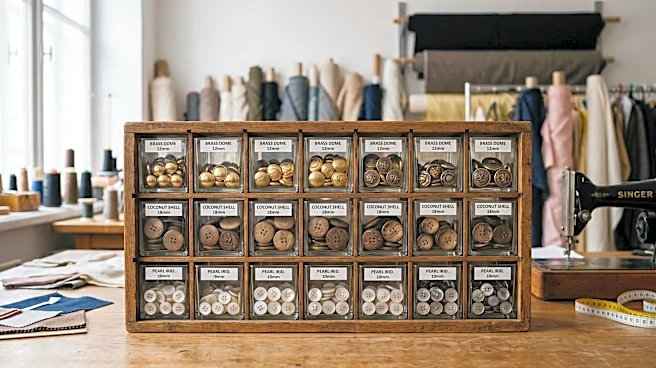

It seems counterintuitive, like organizing a library by book color instead of author. But in the high-stakes world of film and television, sorting spare buttons with their specific garment is a stroke
of logistical genius. Here's why.
The Unforgiving Need for Speed
Imagine this: an actor is mid-scene, delivering a pivotal line, when a button pops off their jacket. The director yells 'cut', the entire crew waits, and the clock is ticking—on a major film set, a delay of even a few minutes can cost thousands of dollars. In this moment, no one has time for a wardrobe assistant to sift through a massive container labeled 'small, brass, shank-back buttons'. The only thing that matters is finding the exact replacement button for that specific jacket and sewing it on immediately. By keeping a small bag of spare buttons attached to the garment's hanger or inside its storage bag, the solution is instantaneous. The costumer grabs the garment, the spares are right there, and the repair is made in seconds, not minutes. It’s a system born from the brutal efficiency required on a professional set, where every second counts.
Continuity Is Everything
Movies and TV shows are almost never filmed in chronological order. A scene that takes place on a Tuesday might be filmed three weeks after a scene that happens on Wednesday. This means a character’s costume must look identical across scenes shot days, weeks, or even months apart. This is where sorting by style fails catastrophically. A 'white shirt button' might seem generic, but there are infinite variations in shade, sheen, thickness, and material. Even buttons from the same factory batch can have minute differences. If a replacement button is even slightly off, it creates a continuity error that sharp-eyed viewers will spot, breaking the illusion of the story. By keeping original spares with the original garment, costume supervisors guarantee a perfect match every single time, preserving the visual integrity of the production. This meticulous tracking is often part of a larger 'Costume Bible' that documents every single item worn.
The Garment as a Complete Unit
In a costume department, a character’s outfit for a particular scene is treated as a complete, self-contained unit. This 'look' includes the shirt, pants, jacket, shoes, and all accessories, from jewelry down to the last button. Everything is often bagged, labeled, and stored together by character and scene number. It makes logistical sense, then, for the garment's repair materials to be part of that unit. The wardrobe supervisor is managing hundreds, if not thousands, of individual pieces. Their system is designed to make each costume traceable and ready to go at a moment's notice. Separating the buttons into a different organizational system would add a layer of complexity that is simply unmanageable under pressure. When an entire outfit is one tracked package, finding a spare part becomes as simple as looking inside the bag.
When a Button Isn't Just a Button
On many productions, buttons are not just functional fasteners; they are key character and story details. They might be custom-made, vintage-sourced, or meticulously aged and dyed to look worn in a specific way. A costume designer might choose a unique set of mismatched buttons to signal a character's quirky personality or use historically accurate bone buttons for a period drama. These aren't items you can find at a local craft store. They are often irreplaceable. Losing one could be a minor disaster, requiring a new one to be custom-made, which is both expensive and time-consuming. Keeping the precious few spares physically tethered to the garment they belong to is the only way to ensure these unique, story-critical details are protected and available for emergency repairs.