



First, What Are the 'Four Quadrants'?
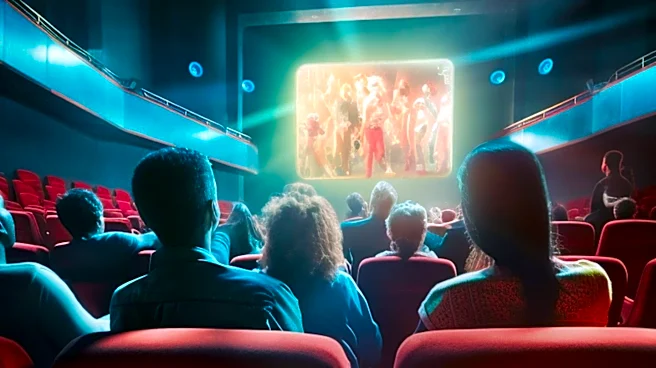
In Hollywood jargon, the audience is divided into four groups, or quadrants: males under 25, males over 25, females under 25, and females over 25. A “four-quadrant” movie is the industry’s holy grail—a film with the magical ability to appeal to all four groups simultaneously.
These are the tent-pole films that studios build their year around, from superhero sagas to animated classics. They require massive budgets because their goal is to capture the widest possible audience, both domestically and internationally. Hitting this target with a story that originates from a science-heavy book is a delicate, high-stakes balancing act that requires a specific strategic playbook.
Find the Primal, Human Story
The first rule of adapting dense sci-fi isn't about the science; it's about the soul. Before a single equation is simplified, screenwriters and producers must locate the universal human theme at the story's core. Is it a story about survival against impossible odds? A tale of a parent's love stretching across time and space? A journey of hope and human ingenuity? Andy Weir’s novel The Martian is packed with orbital mechanics and botany, but the film succeeded because it was fundamentally a story of resilience. Denis Villeneuve’s Arrival is based on a complex linguistic novella, but the movie resonates because it's a profound story about grief, motherhood, and communication. The science becomes the setting for a primal story that anyone, in any quadrant, can connect with emotionally.
Anchor the Concept With a Movie Star
Complex ideas can be intimidating. A familiar face is not. Casting a beloved, bankable movie star is a crucial strategy for making esoteric material feel accessible. The star acts as the audience's anchor and guide into a potentially confusing world. Would as many people have flocked to see The Martian without the everyman charm of Matt Damon? His presence signals that even with all the technical talk, this is a human journey. Similarly, Amy Adams in Arrival and Sandra Bullock in Gravity provided the emotional grounding that allowed viewers to invest in the high-concept premises. The star’s persona effectively tells the audience, “Don’t worry about the astrophysics; I’ll get you through this.”
Visualize the Unseen
Novels can spend pages explaining theoretical physics or the mechanics of an alien language. Film, as a visual medium, has a different toolkit. A great adaptation doesn’t just tell you about an idea; it shows you in a way that’s awe-inspiring. A book might describe the warping of spacetime, but a film like Interstellar creates a breathtaking visual sequence of a ship passing through a wormhole. This is where the budget for a blockbuster sci-fi film is truly spent: turning abstract concepts into visceral, unforgettable cinematic moments. Instead of getting bogged down in exposition, filmmakers use sound and image to convey the wonder, danger, and scale of the science, making it an experience rather than a lecture.
Streamline, Don't Dumb Down
The biggest fear for fans of any source material is that Hollywood will “dumb it down.” Successful adaptations avoid this by streamlining, not simplifying. A 400-page novel contains subplots, secondary characters, and detailed explanations that simply won't fit into a two-hour film. The art of adaptation lies in surgically removing what isn’t essential to the core emotional and narrative thrust. The goal is to preserve the intelligence and spirit of the book while ensuring the plot maintains momentum. It’s about choosing which scientific concepts are critical to the story and finding elegant, cinematic ways to explain them, while letting other, more tangential details fall away. The film has to work as a film first.